
Imagine this: Two companies offer almost identical services, at similar prices, with comparable quality. Yet one of the two regularly wins the contract. Its sales team has to do less convincing, price discussions are shorter, and inquiries seem to come almost on their own. The difference? The brand.
What many managing directors in medium-sized businesses underestimate is this: even in B2B, people buy from people. And people trust brands they know, that appear professional, and that clearly communicate what they stand for. According to the LinkedIn B2B Marketing Benchmark 2025, 94% of surveyed B2B marketers confirm that trust is the central success factor in business relationships. At the same time, 42% of senior marketers name brand awareness and reputation as their most important business priority.
In our work with medium-sized companies from industries such as consulting, real estate, technology, and services, we keep seeing the same pattern: companies with outstanding expertise, but an external presence that fails to convey that expertise. The result is longer sales cycles, more price negotiations, and lost contracts to competitors who simply appear more professional.
This article shows you why B2B branding is not a marketing luxury, but a strategic lever for growth. You will learn which building blocks make up a strong B2B brand, which mistakes you absolutely need to avoid, and how you can approach your own branding project.
This article is aimed at managing directors, business owners, and marketing decision-makers in medium-sized B2B companies. If you notice that your sales conversations too often end up focusing on price, that your external presence does not reflect what your company is truly capable of, or that potential customers are being lost to more visible competitors despite the quality of your work, then this article is for you. It is also relevant if a rebranding is on the table or if you are currently thinking about how to strengthen your market position in a sustainable way.
B2B branding is the strategic development and management of a corporate brand in order to systematically build trust, differentiation, and business success in the business-to-business environment. It involves far more than just a logo or a corporate design. A B2B brand defines how your company is perceived, what expectations it creates, and what kind of impression it leaves on decision-makers.
Even so, especially in the German mid-market, there is still a widespread assumption that branding is only relevant for consumer goods. Many business owners are convinced that their customers make decisions solely based on facts, technical data, and price. This assumption is demonstrably false.
Studies show that 71% of B2B buyers have essentially made their purchase decision before they actively begin looking for specific solutions. This means that if your brand is not already present in the minds of decision-makers at this early stage, you lose the contract before you even get the chance to start a conversation. On top of that, 78% of B2B buyers say they now spend more time researching before making a purchase than they did just a few years ago. Your brand is therefore the first impression potential customers get, and that impression plays a decisive role in whether you make the shortlist or not.

The effects of professional B2B branding go far beyond simply “looking good.” A strong brand changes how your sales team works, how customers perceive you, and ultimately how your company grows.
First of all, a clearly positioned brand attracts the right target audience. Instead of having to laboriously convince every potential customer, inquiries come from prospects who already understand what you stand for. Lead quality improves, and the closing rate increases.
At the same time, a strong brand creates crystal-clear differentiation. In markets where services and products are objectively hardly distinguishable, the brand is the factor that wins the contract. It makes visible why a company is different, not just what it offers.
In addition, professional branding reduces friction throughout the entire sales process. When a prospect lands on your website and immediately gets the impression that they are dealing with a competent, established partner, many of the usual fundamental discussions disappear. The conversation starts at a different level. Instead of “Why should we trust you?”, the question becomes “How can we work together?”
And last but not least, a strong brand enables fair pricing without discount battles. Companies that are perceived as premium can charge premium prices. Those that appear interchangeable are compared on price. The formula is simple: better branding = fewer objections = more trust = more revenue.
Branding in B2B generally follows principles similar to those in B2C: it is about recognition, trust, and emotional connection. But the conditions differ significantly, and that is exactly why B2B branding requires its own approach.
In B2C, a single person often makes a spontaneous decision at the shelf or in an online shop. In B2B, things are different. Purchasing decisions go through complex processes involving multiple participants. A so-called buying center can consist of up to ten different stakeholders, from the technical advisor to the procurement manager to the managing director. Each of these decision-makers has different priorities, different questions, and different concerns. Your brand must convince on every level.
On top of that, sales cycles in B2B are much longer. While a consumer decides in minutes, a B2B purchasing process takes days, weeks, or even months. Throughout this entire time, your brand acts as a silent companion. It influences whether your company stays on the shortlist during the evaluation phase or drops off it. 66% of B2B buyers begin their research process with a Google search. What they find there, and how it looks, shapes their entire perception.
Perhaps the most important difference is this: in B2B, much more is at stake. A buyer who chooses the wrong software, the wrong service provider, or the wrong machine risks, in the worst case, their job. That is why trust in B2B is not a “nice to have”, it is the basic currency of every business relationship. And building trust is the core task of a strong brand.
Building a B2B brand is not a single project with a clear endpoint. It is a systematic process that includes multiple dimensions. If one of these dimensions is missing or weak, the overall picture suffers.
Everything starts with a question that surprisingly many companies cannot answer clearly: what do we actually stand for? Positioning defines your place in the market. It makes clear who you work for, which problem you solve, and why you are the right choice to solve it. Without clear positioning, everything else remains superficial. You can have the most beautiful logo in the world, but if nobody understands what differentiates you from your competitors, it is ineffective.
94% of all first impressions are based on visual design, and that first impression is formed within 50 milliseconds. That is not a conscious decision, it happens in the brain’s “energy-saving mode.” In that split second, the other person decides whether they perceive you as professional, trustworthy, and competent, or not.
Visual identity includes far more than just a logo. Colors, typography, imagery, layouts, and the overall design of your materials, from your website to your presentation deck to your email signature, together form the visual image of your brand.
How you communicate is just as important as what you communicate. Your brand’s tone of voice should be consistent across your website, social media, proposals, and personal conversations. Decision-makers sense inconsistencies intuitively, and they undermine trust.
In most cases, your website is the first direct point of contact between your company and potential customers. 45% of B2B buyers visit provider websites directly as part of their research. If that digital presence does not convince, even the best sales team will not help.
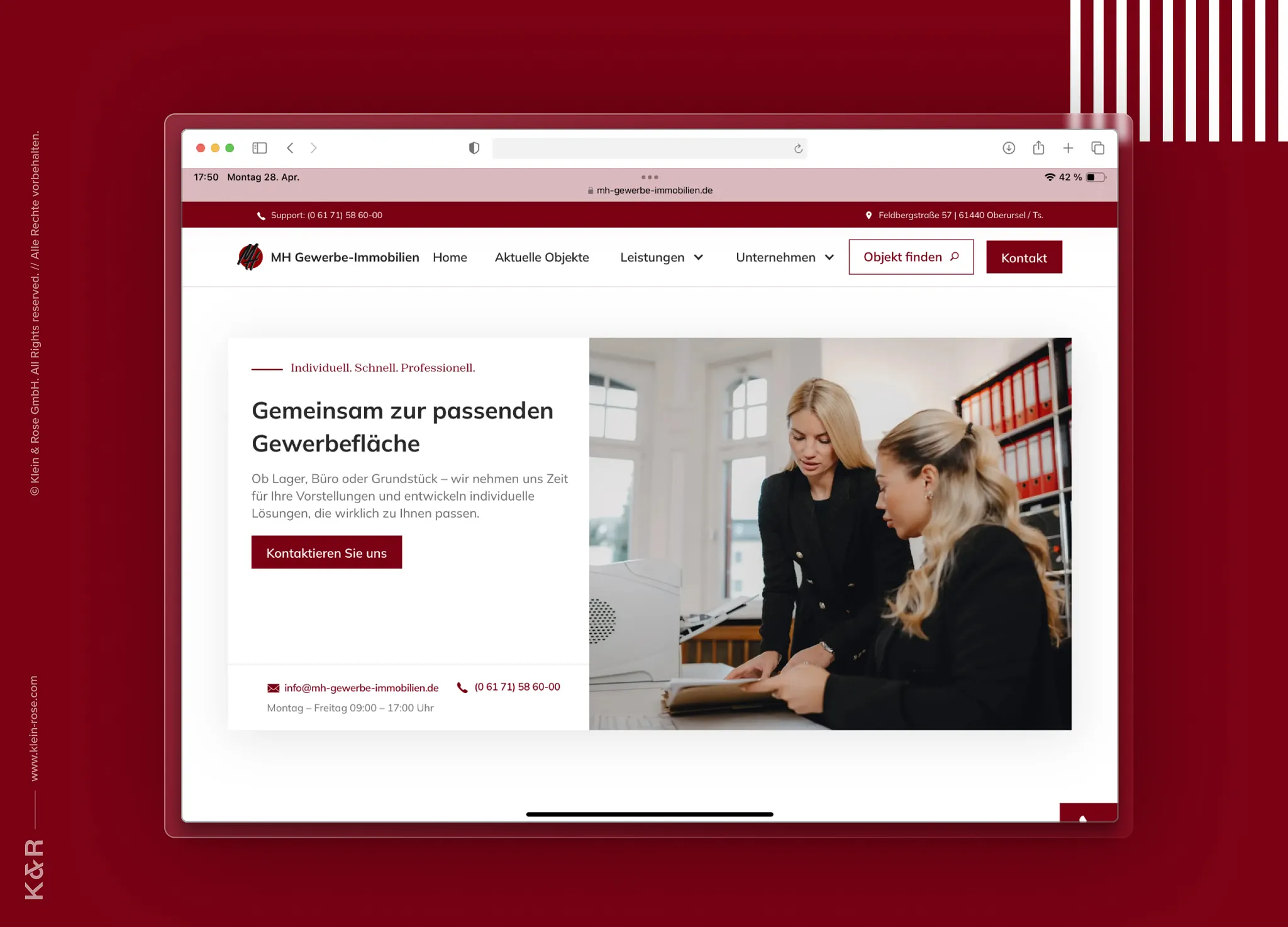
An example from our work: when we completely redeveloped the external brand presence of proQtech, an electronics distributor in the international B2B environment, the central challenge was that the company’s expertise was simply not visible online. The solution was a well-thought-out brand identity and a sales-psychology-optimized website that communicated proQtech’s strengths with precision. The result: the lead rate more than doubled, and typical objections in sales conversations practically disappeared. The client’s feedback: “The brand works for us 24/7.”
Theory is one thing, practice is another. What distinguishes companies whose brand truly becomes a growth driver from those where branding remains little more than lip service?
Across more than 60 branding projects for companies in a wide range of industries, we have observed a recurring pattern: the most successful projects do not begin with design, but with strategy. Companies that first clarify their positioning and then consistently align all touchpoints with it achieve significantly better results than those that simply “refresh the logo” on the side.
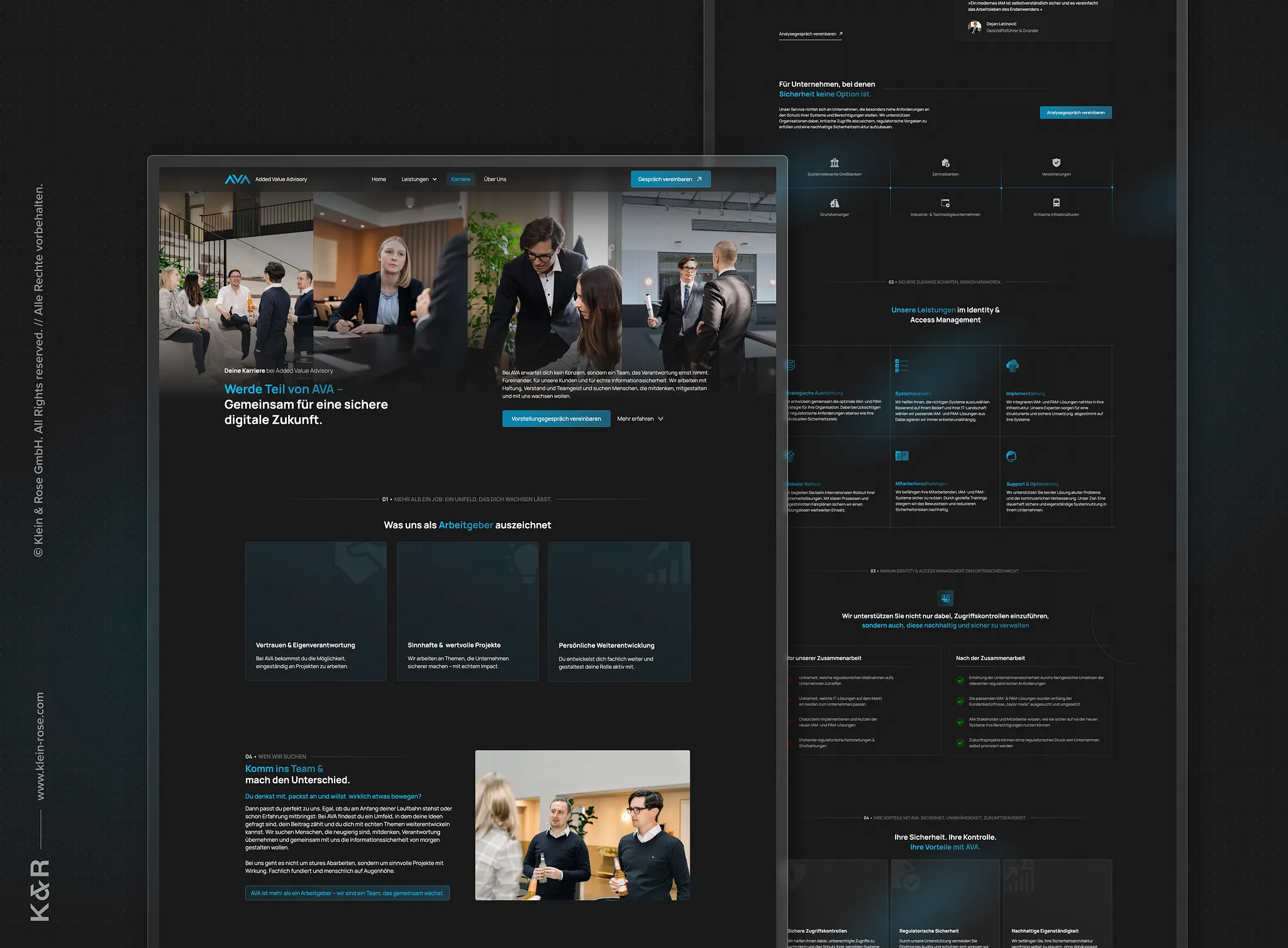
Our project with VAP (Venture Advisory Partners), an M&A advisory firm, shows what this looks like in practice. Before the rebranding, the company was professionally excellent, but its brand presence did not communicate that excellence. After redeveloping the entire brand identity, from positioning and design to the website, qualified initial conversations increased by 40%. The client’s feedback: “Trust is practically established before the first call even happens.”
What these companies have in common is this: they do not see their brand as a cost center, but as an investment in sales efficiency. And they have left behind the myth that “a good product is enough.” In a market where 61% of B2B buyers prefer a sales-free buyer journey, meaning they would rather go through the purchasing process without direct sales contact, your brand is often the only thing speaking on your behalf. If it does not convince, you may never even get the opportunity for a personal conversation.
There are several pitfalls that we keep seeing in our work with companies. The most serious one is confusing branding with logo design. A new logo is one element of a brand, not the brand itself. Anyone who commissions a logo without first defining positioning, target audience, and brand core is investing in decoration rather than substance.
Another common mistake is a lack of consistency across all touchpoints. The website looks highly professional, but the presentations look like they came from the early 2000s. Or the LinkedIn profile tells a different story from the company website. Every inconsistency sends a signal: “They do not take things that seriously here.” And that is exactly the opposite of what builds trust.
Many companies also make the mistake of failing to embed their brand internally. Branding only works when the entire team understands and lives the brand identity. If sales communicates differently from marketing, and customer service uses yet another tone, the brand perception falls apart.
And finally: starting too late. Many managing directors only address branding once sales have already started to stagnate or the competitive situation has intensified. Professional B2B branding is most effective when it is used proactively, not as an emergency measure. One of our clients put it perfectly: “Looking back, I should have taken this step a year earlier.”
The way B2B decision-makers search for solutions is currently undergoing a fundamental shift.
What does that mean for your brand? Until now, it was enough to rank on page one of Google. In the future, your brand also needs to appear in the answers of ChatGPT, Gemini, and similar tools. If a decision-maker asks, “Which agency for B2B branding in Germany would you recommend?” and your company does not appear in the AI-generated answer, then for that potential customer, you effectively do not exist.
This significantly changes the requirements of brand management. Companies that invest in high-quality content today, become visible as thought leaders, and consistently prepare their expertise for digital channels are creating an advantage that will become increasingly difficult to catch up with in the coming years. B2B branding and content strategy are becoming more and more closely connected. Your brand must not only be visually convincing, but also present in the right contexts with the right content.
A professional B2B branding project can be divided into five clearly defined phases. This roadmap gives you a realistic orientation for both process and timeline.
Phase 1: analysis and assessment. It starts with an honest look at the status quo. How is your company currently perceived? Where are the gaps between internal perception and external perception? What is the competition doing? This phase includes market and competitor analysis, target group interviews, and an evaluation of all existing materials.
Phase 2: positioning and strategy. Based on the analysis, your brand positioning is developed. This is where the strategic framework is created: brand core, values, target group definition, and the central brand message that guides everything else.
Phase 3: visual identity and design. Now the strategy becomes visible. The logo, colors, typography, imagery, and all visual elements that define your brand are developed. The key here is that every design element must support the positioning.
Phase 4: implementation across all touchpoints. The new brand identity is rolled out across all points of contact: website, presentations, social media, printed materials, trade fair appearances, email signatures, and all other materials. Consistency is the key here.
Phase 5: optimization and further development. A brand is not a static result. After launch, the phase of continuous optimization begins, based on data, feedback, and changing market conditions.
In brief: the typical duration of a complete B2B branding project is two to three months from start to go-live. This includes strategy, design, and implementation, provided that the collaboration is organized efficiently and decision-making processes are kept short.
B2B branding is not a matter of taste, it is a business decision. At a time when purchasing decisions are increasingly made digitally and increasingly influenced by AI, the brand becomes a decisive competitive advantage. Companies that treat their brand as a strategic asset benefit from shorter sales cycles, better closing rates, and a positioning that goes beyond price.
The cost of not investing in branding can be measured: higher customer acquisition costs, lower win rates in competitive situations, and less pricing power. Or, as one of our clients put it: the price of weak brand strength does not show up on the invoice, but in the deals that never happen.
At the same time, AI-driven search systems and new buyer journeys are changing the rules of the game. Companies that invest now in a strong brand and high-quality content secure visibility in the channels that will determine business success tomorrow.
Do you feel that your external presence does not reflect what your company is truly capable of? Let us take a look together at where the greatest opportunities lie. We look forward to getting to know you.
Book your appointment now, free of charge and without obligation.
.webp)


.webp)
.webp)


