You may be wondering right now: Can a website relaunch destroy my Google rankings? The honest answer is: yes, it can. And severely. Studies show that relaunches without SEO support can cost up to 30 percent of organic traffic. In the worst case, it can take months to return to the original level.
That does not have to happen. Because if you consider website relaunch SEO from the very beginning, the relaunch does not become a threat to your visibility, but an opportunity. In over 60 completed projects for companies in industries such as real estate, consulting, and SaaS, we have learned: the difference between a relaunch that destroys rankings and one that improves them lies in the planning.
In this article, we show you step by step how to protect your Google rankings during a relaunch, which SEO measures are necessary before, during, and after the relaunch, and which mistakes you should definitely avoid.
This article is aimed at companies that are planning a website relaunch and want to avoid putting their Google rankings at risk. It provides clear guidance on which SEO measures are truly critical before, during, and after the relaunch.
If you want to make sure your relaunch becomes a strategic opportunity rather than a ranking risk, you are in the right place.
Website relaunch SEO includes all search engine optimization measures carried out before, during, and after a relaunch in order to maintain or improve existing rankings and organic traffic. Without these measures, companies risk a significant loss of visibility in search results.
Let us look at why this is so critical. Your existing website has built organic rankings over months or years. Google has crawled, indexed, and evaluated your pages. Every URL, every page title, every internal link is part of a complex system that determines where you appear in search results.
If you change URLs, remove content, or completely restructure your site during a relaunch without informing Google, the following happens: Google can no longer find your old pages, the accumulated signals are lost, and your rankings drop. This is not a theoretical scenario. It regularly happens to companies that treat SEO during a relaunch as an optional add-on.
One thing is clear: without SEO there are no rankings, without rankings there is no traffic, and without traffic there are no inquiries. A relaunch without an SEO strategy is like moving to a new address and forgetting to set up mail forwarding.
.webp)
Even with a perfectly planned relaunch, temporary ranking fluctuations are normal. Google typically needs four to twelve weeks to process all changes and fully evaluate the new website. During this phase, rankings may fluctuate temporarily without indicating a long-term problem.
What matters is the difference between a short-term fluctuation and a permanent loss. Temporary shifts of one or two positions in the first weeks are normal and usually correct themselves if the relaunch has been implemented properly. Permanent losses occur when fundamental SEO mistakes are made, such as missing redirects, deleted content, or technical issues.
At K&R, we know that staying calm in the first weeks after launch is just as important as technical preparation. Reacting in panic to short-term fluctuations and making rushed changes often causes more damage than necessary.
The most important phase for your SEO success takes place before a single pixel of the new website is designed. Thorough preparation is your best protection against ranking losses.
Generate a full scan of your current website. Capture every URL, every page title, every meta description, and all internal links. Tools such as Screaming Frog or Sitebulb can do this in just a few minutes. Store this data carefully. It will serve as your reference throughout the entire relaunch process.
Export performance data from Google Search Console. Identify the pages with the highest organic traffic and the keywords you are currently ranking for. This data shows you which pages must be especially protected because they hold the greatest business value.
94 percent of first impressions are based on visual design. But 100 percent of organic traffic is based on search engine optimization. That is why SEO during a relaunch deserves at least as much attention as design.
Backlinks, meaning links from external websites to your pages, are one of the most important ranking factors. Identify the pages with the most and most valuable backlinks. These pages must not be deleted without proper redirects, otherwise you will lose valuable link equity that has been built up over years.
Develop the structure of your new website with SEO in mind. The URL structure should be logical, flat, and easy to understand for both users and search engines. Avoid unnecessary depth in your hierarchy and ensure that your URLs are descriptive and include your primary keyword.
Now it becomes practical. These eight measures are the core of your website relaunch SEO strategy. Implement every single one of them, and your rankings will not only survive the relaunch but benefit from it in the long term.
Redirect mapping is the single most important measure in the entire relaunch. Create a table that assigns every old URL to the corresponding new URL. Each redirect must be set up as a 301 redirect, meaning a permanent redirect.
Briefly explained: a 301 redirect tells search engines that a page has permanently moved to a new address. It transfers most of the ranking signals and link equity from the old URL to the new one.
Crucial: redirect every old URL to the most relevant new URL in terms of content. Do not redirect everything to the homepage or to a general category page. If the old URL was /services/webdesign, it must point to the new web design page, not to /about-us.
A redirect chain occurs when a URL passes through multiple steps before reaching its final destination, for example A redirects to B, B to C, and C to D. Every additional step costs loading time and weakens the transferred ranking signals. The rule is simple: every old URL must redirect directly to the final new URL. No detours.
While working on the new website, the staging environment, meaning the test version, must be excluded from search engine indexing. Use a noindex tag or protect the staging site with a password. Otherwise, Google may index your unfinished website, which creates confusion.
Page titles and meta descriptions are often lost during a relaunch because fields in the new CMS are named differently or are not migrated properly. Keep proven, high-performing page titles. Optimize meta descriptions so they encourage clicks and include your primary keyword.
Internal links are the nervous system of your website. They show Google which pages are important and how your content is connected. Make sure all internal links point to the new URLs, that no outdated URLs remain in links, and that your most important pages receive the strongest internal linking.
The XML sitemap is the roadmap of your website for search engines. Create a new sitemap that includes all new URLs. Remove deleted pages. Submit the updated sitemap to Google Search Console immediately after go live.
If your old website used structured data, also known as schema markup, ensure that it is correctly implemented on the new website. Structured data helps Google better understand your content and can lead to enhanced search results, such as rich snippets.
A relaunch is the perfect opportunity to improve your website’s performance. Google favors fast pages over slow ones. Optimize images, minimize CSS and JavaScript, use browser caching, and choose powerful hosting. 50 milliseconds are enough for a first impression. But if your page takes three seconds to load, the visitor is already gone.

Viele Relaunches scheitern nicht an der Technik, sondern am Content. Inhalte werden gekürzt, gelöscht oder umstrukturiert, ohne die SEO-Konsequenzen zu bedenken. Eine systematische Content-Migration verhindert genau das.
Many relaunches fail not because of technology, but because of content. Pages are shortened, deleted, or restructured without considering the SEO consequences. A systematic content migration prevents exactly that.
Evaluate every existing piece of content using three categories:
Keep – Pages that rank well, generate significant traffic, and are relevant to your target audience. These should be retained or only minimally adjusted. Change as little as possible here, because every modification to high-performing content carries a risk.
Improve – Pages with potential that are outdated, too thin, or poorly optimized. Revise these during the relaunch. Add more depth, improve the structure, and update the information. But make sure the core topics and target keywords remain intact.
Remove – Outdated, irrelevant, or low-quality pages that provide no value. These should be deleted and redirected via a 301 redirect to the most relevant remaining page. Never delete a page without a redirect, otherwise you will create 404 errors.
In our work with mid-sized companies, we regularly see clients delete content too quickly because it looks visually outdated. But visually outdated and SEO-valuable are not mutually exclusive. Always check performance data before removing content.
The work does not end with go live. The first 30 days after a relaunch are critical for your long-term SEO success.
Submit the new XML sitemap in Google Search Console. Check index coverage: are the new pages being indexed correctly? Are the old ones disappearing as planned? Monitor the crawl report for errors. Randomly test the most important redirects to ensure they are working properly.
Track ranking development for your top keywords. Minor fluctuations are normal. Check Google Search Console for 404 errors and fix them immediately with 301 redirects. Analyze organic traffic: are there pages that suddenly have significantly fewer visitors?
Compare current data with the baseline data you secured before the relaunch. Are your rankings stable? Is organic traffic at the expected level? Are there pages that need further optimization? Based on this evaluation, adjust your SEO strategy accordingly.
In most cases, rankings stabilize within four to twelve weeks after a properly executed relaunch. Those who actively monitor the first 30 days and respond quickly can significantly shorten this period.
In over 60 projects, we have seen the SEO mistakes that cause the most damage. Here are the five most common ones so you can avoid them.
Mistake 1: No redirects set up. The classic and most expensive mistake. Any URL change without a 301 redirect means lost rankings and lost backlink equity. This single error can undo months of SEO work.
Mistake 2: Considering SEO only after launch. If you involve SEO only after the new website is already live, the damage is often already done. SEO must be part of the project from the very first concept discussion, not an afterthought.
Mistake 3: Deleting high-ranking content. Pages with strong rankings and high traffic are removed because they “no longer fit the new design.” That is like firing your best salesperson because they do not like the new dress code.
Mistake 4: Not removing the noindex tag after launch. The staging environment was correctly excluded from indexing. But after go live, the noindex tag remains on the live website. Google is not allowed to index your pages and your visibility drops to zero. A mistake that happens surprisingly often.
Mistake 5: No monitoring after launch. The website goes live and no one checks whether redirects work, whether errors occur, or whether rankings decline. Without active monitoring in the first weeks, critical problems remain undetected.
What does a relaunch look like when SEO is considered from the very beginning? An example from our practice shows the difference.
When we redeveloped the entire website for Venture Advisory Partners, an M&A advisory firm, SEO was part of the strategy from day one. We analyzed existing rankings, planned a clean URL structure, implemented all necessary redirects, and aligned the content strategy with the most relevant keywords.
The result: not only were existing rankings maintained, qualified initial consultations increased by 40 percent. Why? Because an SEO-guided relaunch does not just protect rankings, it also lays the foundation for improved visibility. New site structures, optimized content, and better technical performance ensure that Google understands and evaluates the website more positively.
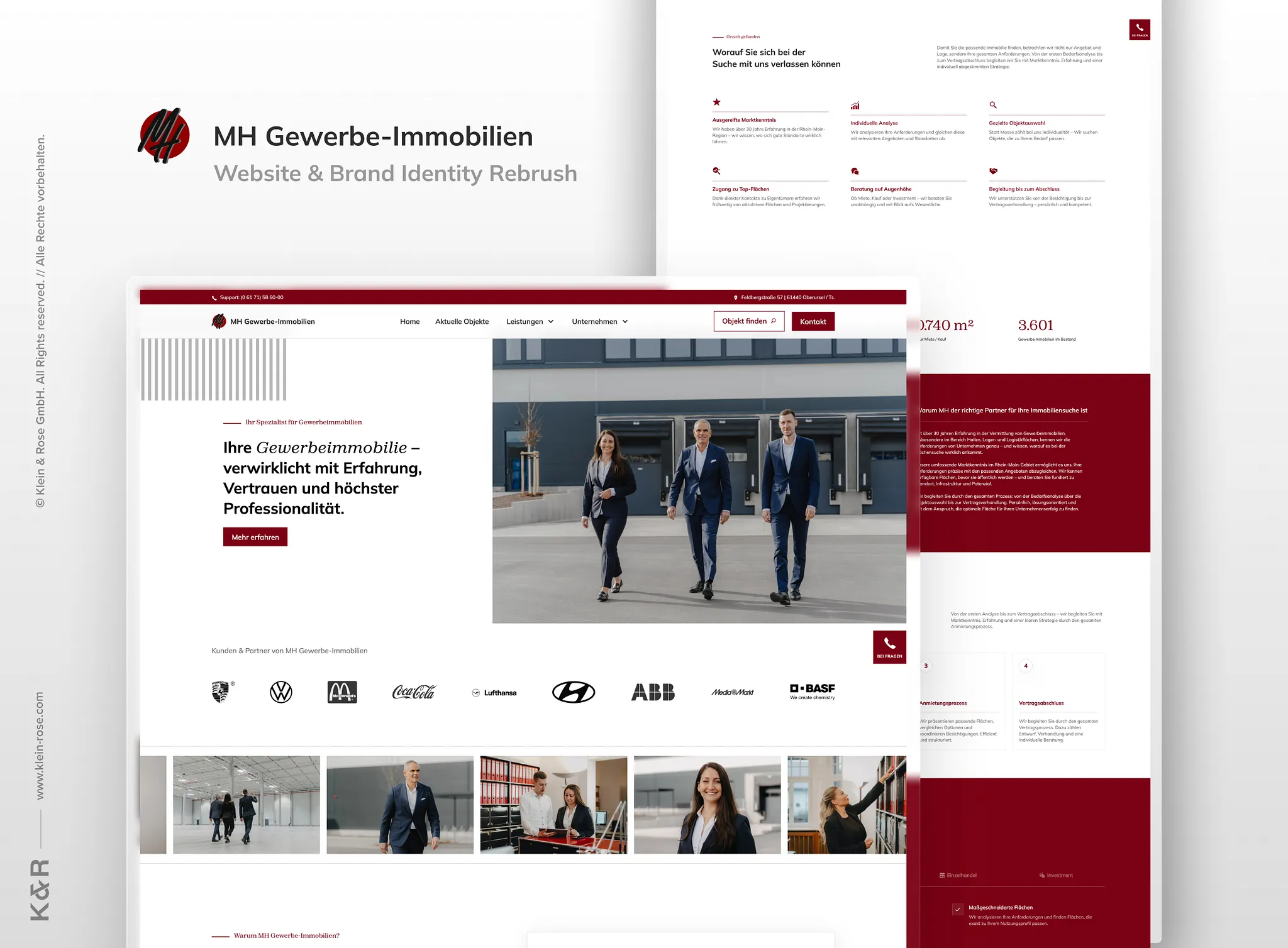
A similar approach was taken for MH Gewerbe-Immobilien. The relaunch included web design, development, SEO, photography, and video. After launch, the client reported more high-quality inquiries and larger deals. His conclusion: “Conversations rarely revolve around basic trust anymore.” That is the effect when a website not only looks good, but is also found.
You can find the complete overview of all relaunch phases in our comprehensive guide to website relaunch.
A website relaunch without an SEO strategy is one of the greatest risks to your digital visibility. At the same time, an SEO-guided relaunch is one of the greatest opportunities not only to preserve your rankings but to improve them in the long term.
The key takeaways from this article: secure all rankings, traffic data, and backlinks before the relaunch. Create a complete redirect mapping for every URL change. Protect high-performing content and never delete anything without a redirect. Actively monitor the first 30 days after launch and respond quickly to errors. And above all, include SEO in the planning from day one, not only after go live.
At K&R, SEO is an integral part of every relaunch project. In over 60 projects, we have proven that a well-planned relaunch does not just protect your visibility, it strengthens it sustainably. Because without branding there is no trust, without trust there is no sale. And without SEO, there is no ranking that brings customers to you.
A website relaunch is a major opportunity when SEO is considered from the very beginning. If you want to ensure that your visibility is not only preserved but continues to grow, we would be happy to talk. No obligation, on equal footing.
.webp)


.webp)

.webp)
.webp)


