Are you investing in your brand presence, but somehow it still does not fully deliver? The website looks professional, yet open positions remain unfilled for weeks. Or the other way around: recruiting is working, but new customers still come only through referrals and price negotiations. If that sounds familiar, the problem is probably not the quality of your branding, but the fact that one crucial brand dimension is missing.
Because branding in B2B is not just branding. There are different types of B2B branding, each with different goals and different target audiences. Companies that treat them all the same or focus on only one dimension are leaving potential on the table. At the same time, not every company needs to tackle all branding types at once. What matters is knowing the right order.
This article shows you which types of B2B branding exist, how they work together, and which one should currently have the highest priority for your company.
This article is aimed at managing directors and marketing decision-makers in mid-sized B2B companies who want to further develop their brand presence strategically. It is especially relevant for you if you are unsure whether corporate branding, employer branding, or product branding currently offers the greatest leverage for your business. It will also give you clear guidance if you are facing the question of how to align different brand levels in a meaningful way.
B2B branding types refer to the different strategic dimensions in which a company can build and manage its brand. The three most important are corporate branding, employer branding, and product branding. Corporate branding is the company brand, employer branding is the employer brand, and product branding is the brand for a specific product or service. Each of these dimensions addresses a different target audience and pursues a different goal.
Why is this distinction so important? Because many companies treat branding as one single, monolithic topic. They have a logo designed, revise the website, and assume that “the branding” is done. In reality, they have only worked on one dimension, usually the corporate brand. The employer brand and any potential product brands are often left out completely.
In practice, this means that a company can present itself very professionally to the outside world and still have major problems attracting skilled talent because the employer brand does not exist. Or it can attract talent with ease but lose contracts to competitors because the corporate brand is not positioned clearly enough. Both symptoms have the same cause: incomplete branding.
.webp)
Corporate branding in B2B describes the strategic development and management of the overarching company brand. It defines what your company stands for, how it is perceived, and what promise it makes to customers, partners, and the market. All other types of branding are built on this foundation.
For the majority of mid-sized B2B companies, corporate branding has the highest priority. The reason is simple: in the mid-market, the company itself is the brand. Unlike large corporations that operate with a portfolio of dozens of product brands, B2B customers here buy the company as a whole, its expertise, its reliability, its people. The company brand is therefore the strongest lever for trust and differentiation.
The building blocks of corporate branding include positioning, visual identity, brand messaging, and consistent implementation across all touchpoints. What matters is not the sum of the individual parts, but how they work together. A professional logo is of little use if the positioning remains unclear. And the best positioning loses its impact if the website does not communicate it.
How significant the effect of well-executed corporate branding can be is illustrated by our project with MH Gewerbe-Immobilien. The company already had an established logo, which was deliberately retained. What was missing was everything else: a consistent corporate design, a professional website, and a visual presence that reflected the company’s actual expertise. After redesigning the brand, website, and creating professional photo and video material, the business dynamic changed noticeably. The inquiries became higher quality, the deals became larger, and conversations hardly revolved around basic trust anymore. The client’s feedback: “Looking back, I should have taken this step a year earlier.”
Employer branding describes the strategic process through which a company positions itself as an attractive employer and differentiates itself from competitors. The goal is to retain existing employees and attract new skilled talent. The result of this process is the employer brand.
It is important to distinguish this from personnel marketing. While personnel marketing includes operational measures to fill positions, such as job board ads or active sourcing, employer branding is a long-term strategic effort. It is not about filling a single vacancy quickly, but about ensuring that your company is generally perceived as an attractive employer.
This is a particular challenge for mid-sized B2B companies. Many of these businesses are hidden champions with outstanding expertise, but little awareness among the broader public. They are often located not in major cities, but in smaller locations where competition for skilled workers is especially intense. And when it comes to attracting talent, they compete with large corporations that already enjoy a trust advantage simply because of their brand name.
According to LinkedIn, companies with a strong employer brand receive up to 50% more qualified applications. That is no coincidence. A well-developed employer brand makes visible what makes a company special as an employer: its culture, development opportunities, values, and day-to-day working environment.
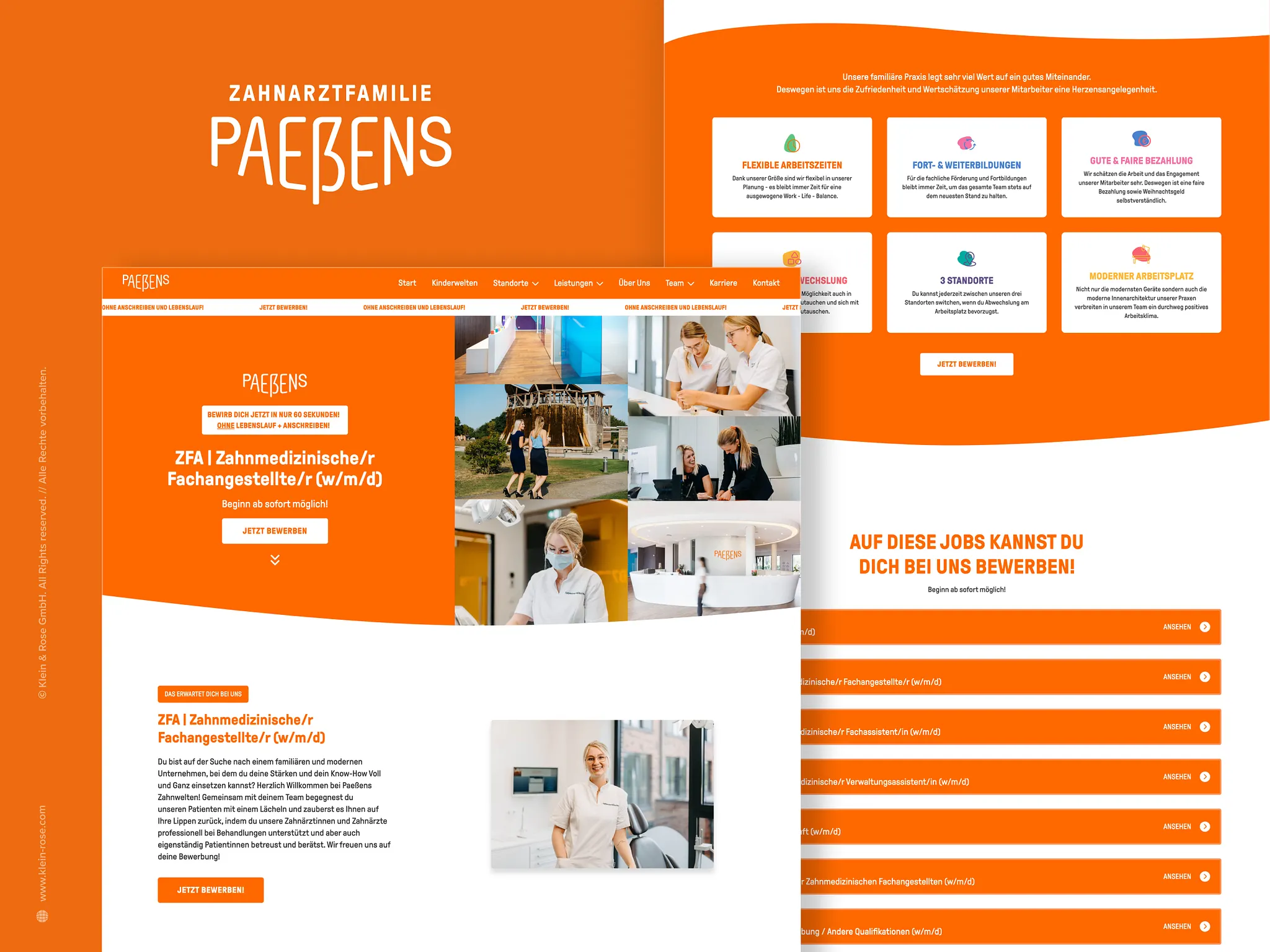
One project that shows what professional employer branding can achieve: for Karl von Drais, we developed a career portal combined with an image film, social recruiting campaigns, and SEO optimization. The result: more than 100 new employees hired. Not through expensive headhunters, but through an employer brand that is both digitally visible and convincing.
What is often underestimated is that employer branding does not only work externally. It also strengthens the identification of existing employees with the company. Employees who are proud of their employer become natural brand ambassadors. And at a time when 84% of job seekers say that a company’s reputation as an employer influences their decision to apply, this internal effect is a strategic advantage that goes far beyond recruiting.
Alongside corporate branding and employer branding, there are two additional types of B2B branding that can be relevant for mid-sized companies: product branding and personal branding.
Product branding, meaning the creation of independent brands for individual products or services, plays a different role in B2B than it does in consumer markets. While corporations such as Procter & Gamble manage dozens of product brands in parallel, most mid-sized B2B companies work with a single company brand that covers all service areas. In most cases, that is also the right strategy. Separate product branding only becomes worthwhile in B2B when individual business units address such different target groups that a shared brand creates more confusion than clarity. Or when a product has such a distinct market position that it would be stronger as a standalone brand.
Briefly explained: in brand architecture, a distinction is made between a branded house and a house of brands. In a branded house, the company brand takes center stage and all services operate under one roof, which is typical for the mid-sized B2B market. In a house of brands, a company manages multiple independent brands, which is typical for large corporations. For most mid-sized B2B companies, the branded-house approach is more efficient and more cost-effective.
Personal branding has gained considerable importance in B2B over the past few years. This refers to the deliberate positioning of managing directors, founders, or subject-matter experts as visible faces of the company. Especially in industries where trust and personal relationships are decisive, a managing director who is perceived as a thought leader on LinkedIn can be a powerful multiplier for the corporate brand. The boundaries between corporate branding and personal branding are becoming increasingly blurred: customers, partners, and talent no longer just want to know what a company offers, but what the people behind it stand for.
Even so, one principle remains true: for the vast majority of mid-sized B2B companies, corporate branding is the logical starting point. Product branding and personal branding only unfold their full effect once the foundation is in place. Without a clear company brand, even a strong personal LinkedIn profile remains an isolated signal without a framework. And without a consistent corporate identity, a product brand feels like a foreign body.
The different types of B2B branding do not exist in isolation from one another. They form a system in which each level strengthens or weakens the others. The company brand forms the umbrella. The employer brand and any potential product brands are extensions built on the values and positioning of that umbrella.
In practice, this interaction only works when all brand levels are developed as one coherent whole. One of the most common mistakes we see is this: companies hire one agency for their corporate branding, another for employer branding, and a third for recruiting. The result is three different visual languages, three different tones of voice, and an overall perception that is anything but consistent.
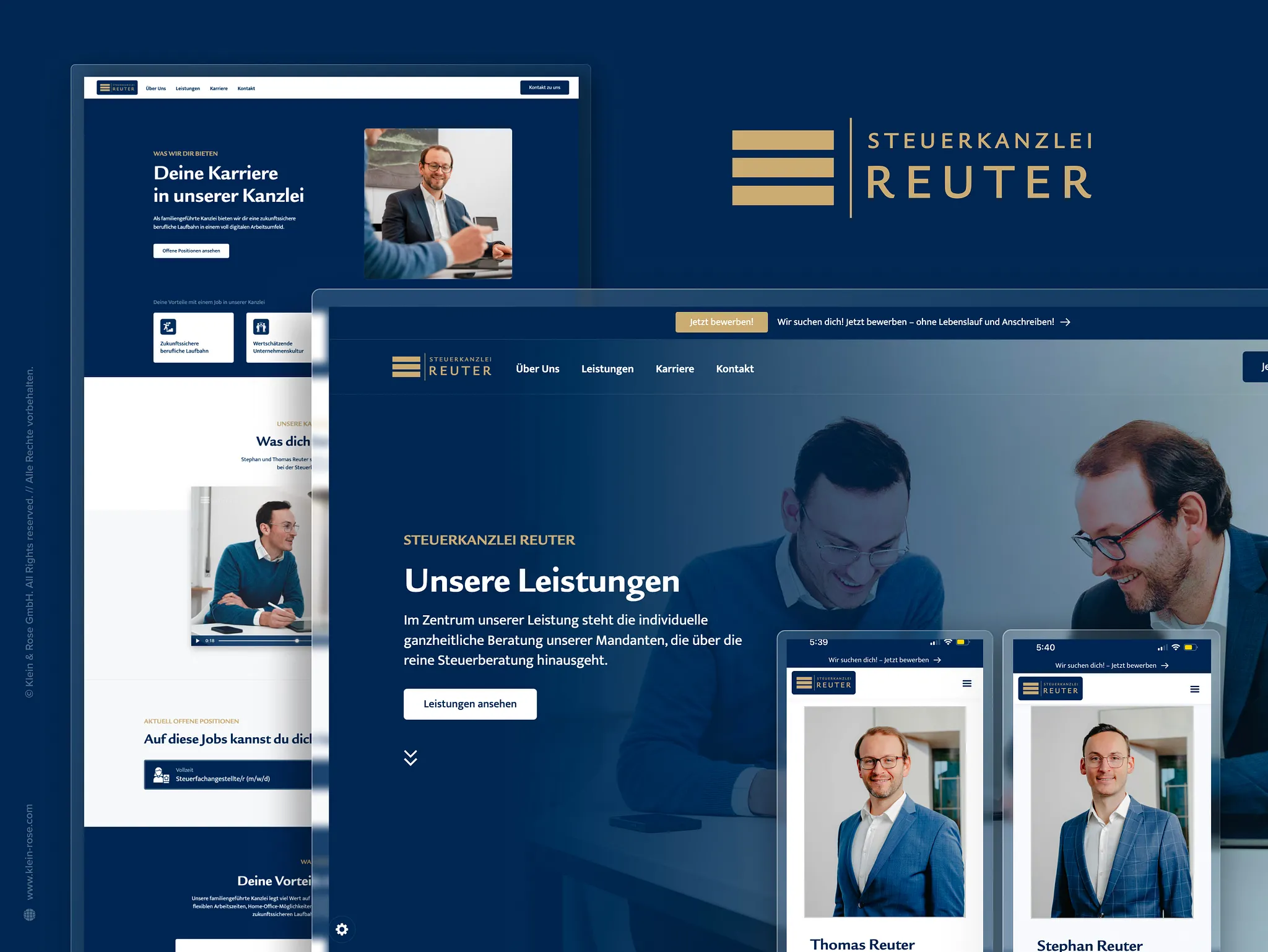
A counterexample from our work is Steuerkanzlei Reuter, a second-generation tax consultancy that wanted both to win new clients and to fill open positions. Instead of treating those two goals separately, we developed both from a single source: brand identity, website, career portal, and SEO. The company brand and the employer brand are based on the same values and the same visual identity. The result: new clients and successful hires, both driven by an online presence that is professional, consistent, and convincing.
What happens when the branding types are not aligned? Contradictions arise, and those contradictions cost trust. A company that presents itself on its website as innovative and dynamic, but uses stock photos and generic phrases on its careers page, sends a conflicting signal. Potential applicants quite rightly ask themselves: which image is true? Customers notice these inconsistencies as well. At a time when prospects do not only check the company website before making a purchasing decision, but also the careers page, social media profiles, and reviews on Kununu, a unified brand image across all levels is no longer optional.
The rule of thumb is this: the employer brand should always be built on the values and positioning of the company brand. It is not a separate identity, but a target-group-specific extension of the same brand core. Companies that understand and implement this build a brand system that works both internally and externally.
The question of where you should start depends on your current situation. Three typical scenarios from our project work can help provide direction.
First scenario: your company does not have a clear, consistent external presence. The website is outdated, the corporate design feels pieced together, and potential customers do not get an immediate sense of what you stand for. In this case, corporate branding is the right starting point. Without a solid foundation, all other measures lack a framework. Invest first in positioning, visual identity, and a website that communicates your expertise at first glance.
Second scenario: your company brand is in place, but you are struggling to find or retain qualified employees. Open positions remain vacant for too long, and the applications you receive are mostly from candidates who do not match your requirements. In this case, employer branding is the next logical step. A professional careers portal, authentic insights into your company culture, and targeted social recruiting can make the difference.
Third scenario: your company is growing and increasingly serving different business areas or target groups. The current umbrella brand feels suitable for some areas, but not for others. In this case, you should clarify your brand architecture. Do you need separate product brands? Or can the existing company brand be developed further so that it covers all areas? Answering this question strategically saves significant costs in the long term and prevents confusion in the market.
Regardless of the scenario, one principle applies: it is better to implement one branding dimension properly than to tackle three half-heartedly. Professional corporate branding that is lived consistently across all touchpoints has a stronger effect than a superficial overall package of corporate, employer, and product branding that fails to convince anywhere.
Distinguishing between the different types of B2B branding is not an academic exercise, but something with direct business relevance. Corporate branding builds trust with customers and strengthens market position. Employer branding secures access to skilled talent. Product branding and personal branding create additional differentiation in complex markets.
What is becoming clear is this: the boundaries between these branding types are increasingly blurring. Customers look at career pages before awarding a contract. Applicants review references and the client portfolio before applying. And on LinkedIn, managing directors are perceived at the same time as thought leaders, employer ambassadors, and sales channels. Companies that think of their brand as an integrated system rather than a collection of isolated measures will achieve the best results in this environment.
At K&R Advertising, we work exactly according to this principle. Whether corporate branding, a career portal, or a holistic relaunch, we develop brand presences in which all dimensions come from one coherent source and reinforce one another. Because we know that a brand only works when it convinces in every direction.
Are you wondering which branding dimension would create the greatest leverage for your company? Let us take a look together at where your company stands and which steps make sense right now. We look forward to the conversation.
Book your appointment now, free of charge and without obligation.
.webp)




.webp)


