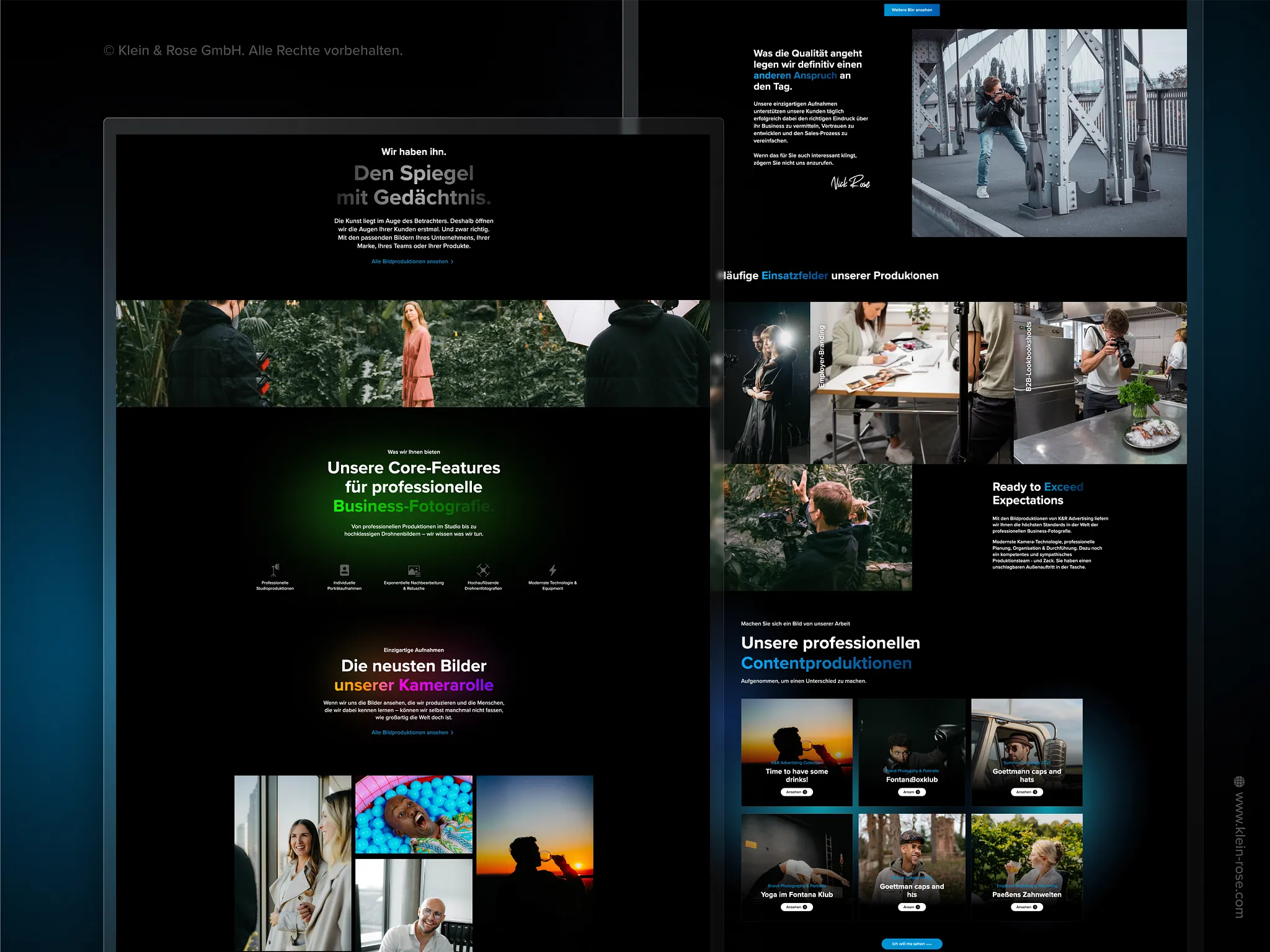
During a branding project for a tax consultancy in the Rhine-Main region, we were faced with a typical situation: the new corporate design was ready, the website had been planned, and the copy had been written. What was missing were images that would bring it all to life. On the day of the shoot, it became clear what good preparation can do. The team knew what to expect. The outfits were coordinated. The rooms were prepared. The result: authentic, professional team photos that now create exactly the intended effect on the website and careers portal.
What we learned from this and many other shoots is this: the quality of a business photoshoot is not decided on the day of the shoot. It is decided in the days and weeks before, through preparation, clear coordination, and the right decisions regarding outfit, location, and process.
This article shows you how to prepare yourself and your team optimally for a business photoshoot, which mistakes to avoid, and what really matters when it comes to clothing, setting, and process.
Have you planned a business photoshoot or are you about to book one? Are you wondering what to wear, how to prepare your team, or what needs to be organized in advance? Then you will find clear answers here. This article is for anyone who wants to get the maximum out of their photoshoot, whether you are a managing director preparing for your first headshot or a marketing decision-maker coordinating a team shoot.
Many companies underestimate how much influence preparation has on the final result. The common assumption is often: we will book a good photographer, and they will take care of it. And yes, an experienced photographer makes an enormous difference. But even the best photographer cannot create first-class results from a poorly prepared shoot.
Imagine this: one employee shows up in a checked shirt, another in a black suit, and a third in a bright T-shirt. The meeting rooms are full of binders and clutter. And half the team has no idea why photos are being taken today. The result will be images that may be technically fine, but that create no consistent overall impression. No common thread, no brand message, no professional coherence.
The difference between an average photoshoot and an outstanding one rarely comes down to the camera. It comes down to planning. If you clarify in advance which images are needed, who should wear what, which rooms will be used, and what the schedule looks like, you create the foundation for photos that truly work.
You can find more details on the strategic role of business photography and why it is much more than just attractive images in our guide: Business Photography for Companies.
The question “What should I wear for a business photo?” is one of the most common before a shoot. And rightly so, because clothing has a major influence on the impact of the images. There is no universal right or wrong here, but there are proven principles that work in almost every industry.
The most important principle is this: your clothing has to match your industry and your brand. A management consultant will choose different outfits than a creative studio. A law firm dresses differently from a tech startup. Ask yourself: what would our clients expect when they meet us for the first time? Your outfit should reflect exactly that expectation.
Colors and patterns are a common stumbling block. Solid-colored clothing in muted tones almost always works well in photos. Navy, anthracite, white, black, and subdued earth tones create a strong foundation. Avoid very small patterns such as fine stripes or checks, because these create an unpleasant flickering effect in photos that cannot be corrected afterward. Very bright colors also distract from the face and dominate the image.
Briefly explained: the flickering effect caused by small patterns in photos is known as the moiré effect. It occurs when fine, regular patterns interfere with the camera’s pixel grid. The result is disturbing wave-like lines in the image that can hardly be removed even in post-production.
Fit is more important than brand. A well-fitting shirt from the mid-price range will look better in photos than a poorly fitting designer suit. Make sure nothing feels too tight, pinches, or shifts out of place. And wear clothing in which you feel comfortable. Discomfort shows in your body language and therefore in the image.
When it comes to accessories, less is more. A subtle watch, a simple ring, or understated jewelry can complete an outfit. Eye-catching necklaces, large earrings, or patterned ties, on the other hand, distract and make images feel dated more quickly. Keep in mind that your business photos should ideally still look current in two to three years.
If several people are being photographed, another factor comes into play: coordination within the team. That does not mean everyone has to wear the same thing. It means the outfits should fit together in terms of color palette and level of formality. If management shows up in suits while the team wears jeans and sneakers, the group photo will feel inconsistent. Define a dress code or a color palette in advance and communicate it early enough.
For business photos that are meant to serve as professional individual portraits, one simple rule of thumb applies: dress one level more formally than in your normal everyday work routine. If you normally wear a shirt without a tie in the office, add a blazer for the shoot. This slight step up looks professional in photos without making you look overdressed.
Alongside clothing, the location is the second most important preparation factor. Where the shoot takes place affects the atmosphere, the lighting conditions, and the overall impact of the images.
The most obvious option is your own business premises. This offers several advantages at once: your team feels more comfortable in familiar surroundings, there are no additional rental costs, and the images show your actual working environment. However, the rooms need to be prepared accordingly. Clear desks, remove personal items that do not belong in the shot, and pay attention to backgrounds. A crowded pinboard or a messy shelf in the background can ruin an otherwise strong portrait.
An external studio offers controlled conditions: even lighting, neutral backgrounds, and professional equipment on site. This is especially useful if your office spaces have little daylight, are not visually representative, or if you are aiming for a particularly clean look. The downside is that rental costs arise and the images do not show your real work environment.
Outdoor shoots can be an interesting option for certain brands and industries. Architecture, an urban setting, or nature in the background can give images a distinctive character. However, here you are much more dependent on weather and lighting conditions. For outdoor shoots, always plan an alternative date or an indoor backup location. By the way, the ideal time for outdoor images is not the midday sun, but the morning hours or late afternoon, when the light is softer and more flattering.
Regardless of the location, light is the most important technical factor. Natural light from large windows often delivers the most flattering results. If your photographer brings their own lighting equipment, that is a good sign of professionalism. If possible, avoid rooms with only fluorescent lighting, because that kind of light creates an unflattering green cast that is difficult to correct in post-production.
Not everyone enjoys being in front of the camera. Many employees feel nervous, unsure, or even resistant before a photoshoot. That is completely normal and can be handled well with the right preparation.
The most important step is early communication. Inform your team at least two weeks before the shoot, ideally earlier. Explain why the photos are being taken, where they will be used, and what the employees can expect. People cooperate better when they understand the purpose. “We are taking new team photos for the website” is more helpful than “A photographer is coming on Tuesday.”
Give clear guidance on clothing and process. Send a short summary by email: recommended colors, patterns to avoid, time slots per person, and meeting point. The less uncertainty there is, the more relaxed employees will be on the day of the shoot.
Allow enough buffer time on the shooting day. If each person only has ten minutes for their portrait, time pressure builds up, and time pressure is the enemy of good photos. It is better to plan 20 to 30 minutes per person, including warm-up, position changes, and a short breather. The atmosphere on set shows directly in people’s faces.
An experienced photographer knows how to relax even people who are camera-shy. Still, as the client, you can help: provide drinks, create a relaxed atmosphere, and communicate clearly that no one has to look perfect. Authenticity beats perfection. The best team photos are created when people feel comfortable, not when they are trying to play a role.
That is exactly the experience we had in the branding project for Steuerkanzlei Reuter. The second-generation tax consultancy needed a completely new brand presence, including a website and careers portal. The team photos were a central element because they were meant to position the firm as a modern and approachable employer. Through careful preparation, clear briefings for the team, and a relaxed shooting atmosphere, images were created that communicated exactly that. The result: new clients and successful hires through a professional online presence that builds trust.
Especially when team photos are also intended for recruiting purposes, extra care is worth it. Applicants look closely at the team page and immediately notice whether the images feel authentic or staged. You can find more on how photography works within employer branding in our Employer Branding Guide.
From our experience with numerous shoots for companies across many different industries, we know the pitfalls that come up again and again. If you avoid these five mistakes, you will already be one big step ahead of most others.
Mistake 1: Not allowing enough time. Trying to squeeze a complete team shoot with 10 people into two hours may sound efficient, but it leads to rushed images and stressed faces. Plan generously. Half a day is realistic for a team of that size, and a full day for individual portraits plus team images plus situational shots.
Mistake 2: Not creating a briefing. Without a briefing, the photographer will shoot according to their own taste. That may work out, but it does not have to. Define in advance which visual style you want, collect reference images, and talk about your brand. A good photographer will incorporate this information into their work.
Mistake 3: Not coordinating outfits. Individually, every outfit may look good. But when five completely different style worlds collide in a team photo, the image feels disharmonious. At the very least, coordinate the color family and the level of formality.
Mistake 4: Planning images for only one channel. Many companies plan a shoot only for the website and do not think about social media, careers pages, press materials, or print products. Brief the photographer for different formats: landscape for website headers, portrait for Instagram and LinkedIn, and square crops for profile pictures. That way, you get much more value out of a single shoot. You can find a breakdown of what different formats cost in our cost article.
Mistake 5: Treating photography separately from branding. This is perhaps the most serious mistake. If the images do not fit your brand’s color palette, tone of voice, and positioning, a break appears in the overall presence. The best way to avoid this is to treat photography as an integral part of your brand strategy, not as a one-off measure. We explain why this is so important in detail in our pillar article on Business Photography for Companies.
Wie gelingt das beste Businessfoto? Nicht durch Zufall und nicht allein durch teure Ausrüstung. Sondern durch Vorbereitung. Die Entscheidungen, die Sie vor dem Shooting treffen, bestimmen die Qualität der Ergebnisse.
Nehmen Sie aus diesem Artikel drei konkrete Schritte mit. Erstens: Erstellen Sie ein Briefing mit Referenzbildern, Stilrichtung und Einsatzzwecken, bevor Sie einen Fotografen buchen. Zweitens: Kommunizieren Sie Dresscode und Ablauf mindestens zwei Wochen vor dem Shooting an alle Beteiligten. Drittens: Planen Sie großzügig mit Zeit, denn Entspannung ist der wichtigste Faktor für authentische Bilder.
Wenn Sie diese drei Punkte beherzigen, werden Ihre Businessfotos nicht nur professionell aussehen, sondern auch die Wirkung entfalten, die Ihr Unternehmen verdient: Vertrauen aufbauen, Kompetenz zeigen und Ihre Marke sichtbar machen.
Und noch ein letzter Gedanke: Betrachten Sie Ihr Fotoshooting nicht als einmalige Pflichtübung, sondern als wiederkehrenden Bestandteil Ihrer Markenkommunikation. Teams verändern sich, Marken entwickeln sich weiter und auch Bilder haben ein Haltbarkeitsdatum. Wer alle zwei bis drei Jahre frisches Bildmaterial einplant, bleibt aktuell und authentisch. Das muss kein Großprojekt sein. Oft reicht ein halber Tag, um den Bildbestand aufzufrischen und neue Mitarbeiter ins visuelle Gesamtbild zu integrieren.
At K&R, we plan and produce business photography as part of your brand presence. From the initial concept to the final image, aligned with your brand and your goals.
.webp)




.webp)