Do you know whether your company is currently doing personnel marketing or employer branding? If you hesitate for a moment when asked that question, you are in good company. In our conversations with managing directors and HR decision-makers, we regularly see both terms being used synonymously. And that is exactly what leads to neither one nor the other delivering the desired impact.
According to a Deloitte survey, two thirds of German CFOs consider the shortage of skilled workers to be the greatest business risk. So the awareness that companies need to actively compete for talent is definitely there. But implementation often fails because strategic and operational measures are mixed together. In this article, we clarify the difference between personnel marketing and employer branding, show how both disciplines work together, and explain why understanding this distinction is crucial for your recruiting success.
This article is aimed at managing directors, HR leaders, and marketing decision-makers who want to understand how employer branding and personnel marketing are connected and where the boundaries lie. It is especially relevant if you feel that your recruiting measures are not delivering the desired results, even though you are already investing in job ads, social media, or careers pages. For a comprehensive introduction to the topic, we also recommend our pillar article: Employer Branding: The Complete Guide for Companies.
Employer branding refers to the strategic development and ongoing cultivation of an employer brand. It answers the question: what does our company stand for as an employer? This is not about individual measures or campaigns, but about a long-term positioning that is deeply rooted in the company culture.
At its core, employer branding is about three things. First: analyzing your own strengths and weaknesses as an employer. Second: defining an Employer Value Proposition, in other words a clear promise that differentiates you as an employer from your competitors. And third: consistently communicating that promise internally and externally.
Employer branding always works in two directions. Internally, it strengthens the identification of existing employees with the company, increases satisfaction, and reduces turnover. Externally, it positions the company in the labor market in such a way that it becomes attractive to the right talent. Any company that communicates only externally but fails to deliver internally will sooner or later be exposed. Review platforms such as Kununu quickly make contradictions between promise and reality visible.
One aspect that is often overlooked is this: the employer brand is always derived from the corporate brand. It does not stand in isolation, but is part of the overall corporate brand. A company that stands for quality and innovation as a corporate brand must also communicate those same values in its employer brand, because anything else would lack credibility.
Personnel marketing includes all concrete measures a company uses to market its open positions and reach applicants. It is the operational tool used to bring the messages defined in the employer brand to the target audience.
The basic idea is this: companies should market their open positions in much the same way they market their products. That idea is still valid today, but in practice it has evolved enormously. Modern personnel marketing goes far beyond simply posting job ads.
Typical instruments of personnel marketing include job advertisements on job portals and social media, active sourcing and direct outreach, career fairs and recruiting events, applicant management and candidate experience, recruitment agencies and headhunting, as well as employee referral programs. All of these measures aim to fill specific vacancies, as quickly as possible and with the right candidates.
The crucial point is this: personnel marketing is action-oriented and short-term in its focus. It does not ask, “What do we stand for as an employer?” but rather, “How do we reach the right candidates for this specific position?” It is the implementation layer, while employer branding forms the strategic layer.
The distinction can be reduced to one simple formula: employer branding answers the “what” and the “why,” while personnel marketing answers the “how” and the “where.”
Employer branding is a long-term, strategic discipline. It shapes the overall perception of your company as an employer. It addresses both existing employees and potential applicants. It is part of the broader business strategy and is supported by management.
Personnel marketing, on the other hand, is operational and short-term in orientation. It is aimed at filling specific vacancies. It is directed primarily at external candidates. It is typically implemented by HR or by an external agency.
Both disciplines are essential, but they serve different functions. Think of employer branding as the foundation of a house and personnel marketing as the interior furnishing. Without a solid foundation, the furnishing stands on shaky ground. But a foundation alone is not yet a livable house.
You may be wondering: why is this distinction so relevant? Whether I call it employer branding or personnel marketing does not change the results, does it? But that is exactly the misconception that ends up costing many companies a great deal.
When companies engage in personnel marketing without first defining an employer brand, this is what happens: job ads sound interchangeable because there is no differentiated message behind them. The careers page shows open roles, but gives no real sense of what it is actually like to work at the company. Social media posts feel random because they do not follow a coherent thread. And the candidate experience varies depending on the department and contact person, because there is no consistent employer identity.
The result is high effort but disappointing outcomes. Many HR decision-makers know the feeling of placing job ads that generate hardly any qualified applications. Often, the problem is not the ad itself, but the lack of strategic foundation behind it.
The opposite is also true: companies that develop a brilliant employer branding strategy but implement no operational personnel marketing measures remain invisible. The most attractive employer brand is useless if no one hears about it. Strategy without execution is theory. Execution without strategy is activism. Neither one alone leads to success.
Where the difference between employer branding and personnel marketing becomes especially clear is in the candidate journey, meaning the path a potential applicant follows from the first contact with your company to the hiring decision.
Imagine a skilled professional who is not actively looking for a job, but is open to new opportunities. On LinkedIn, they come across a post from your managing director talking about a successfully completed project. The post communicates enthusiasm, competence, and team spirit. That is employer branding in action: it creates a positive image of your company as an employer without promoting a specific opening.
A few weeks later, the same professional sees a job ad from your company on a job portal. Because the company is already positively anchored in their mind, they click on the ad. That is personnel marketing: a targeted measure used to promote a specific position.
The professional now visits your careers page. There, they find employee testimonials, insights into the company culture, and clear information about benefits. That is employer branding again: it confirms the positive impression and builds trust. Finally, they apply through a simple online form, receive a quick response, and are guided through a professional selection process. That is operational personnel marketing and recruiting.
This example makes one thing clear: employer branding and personnel marketing are not alternatives. They are sequential phases of the same journey. And that journey must be consistent. Every break between what the employer brand promises and what personnel marketing actually delivers costs you candidates.
The most effective combination arises when employer branding provides the strategic framework and personnel marketing implements the defined messages operationally. In practice, it looks like this.
First, in an employer branding process, you define your Employer Value Proposition. What makes you unique as an employer? Which values do you live by? What kind of culture exists in your company? And for which talents is that especially attractive? This process requires honest self-reflection, conversations with employees, and a clear positioning against the competition.
From this strategic foundation, you then derive your personnel marketing measures. Your job ads communicate the defined messages. Your careers page reflects your employer identity. Your social media content tells stories that fit the employer brand. And your application process embodies the values you communicate externally.
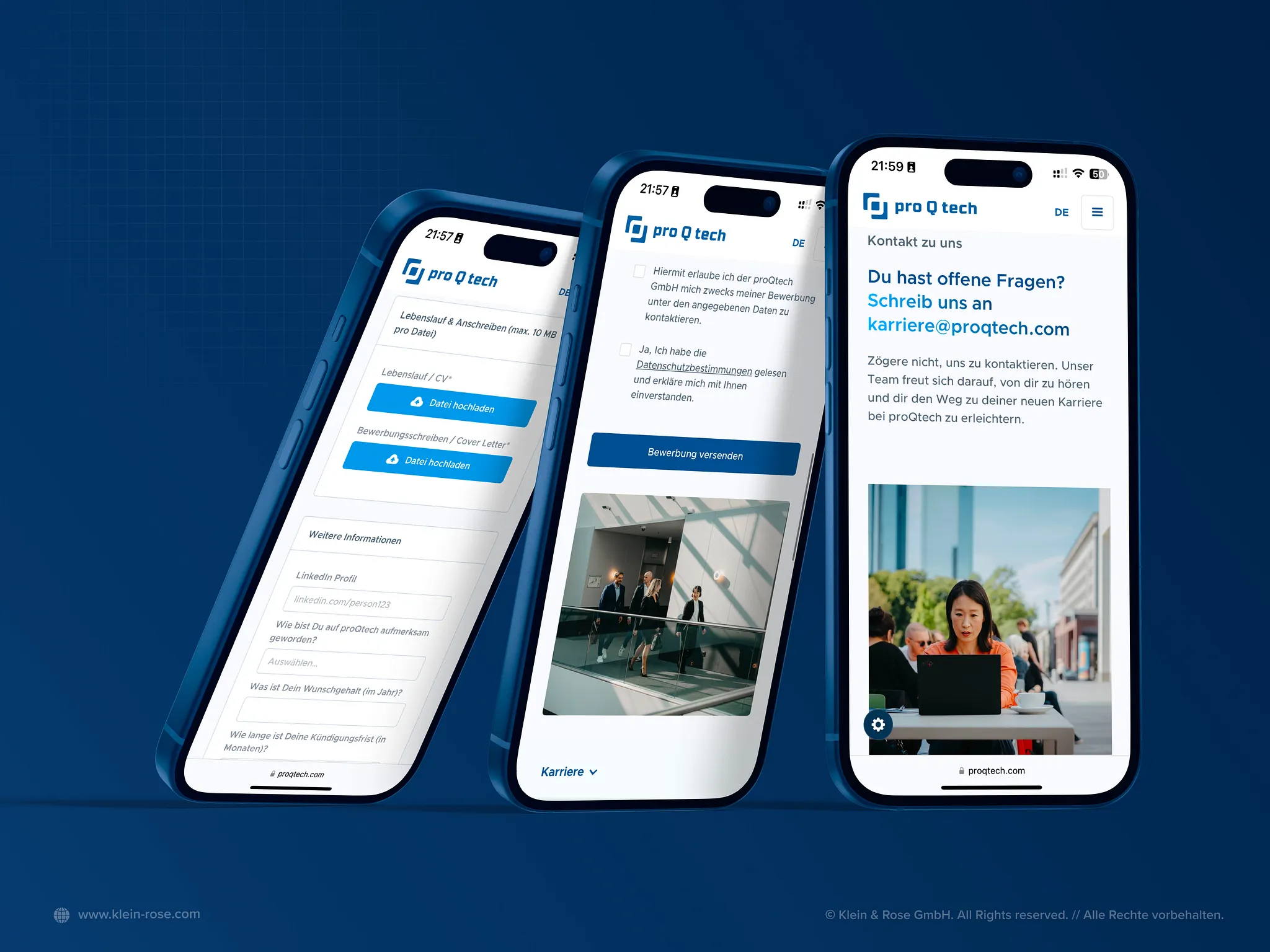
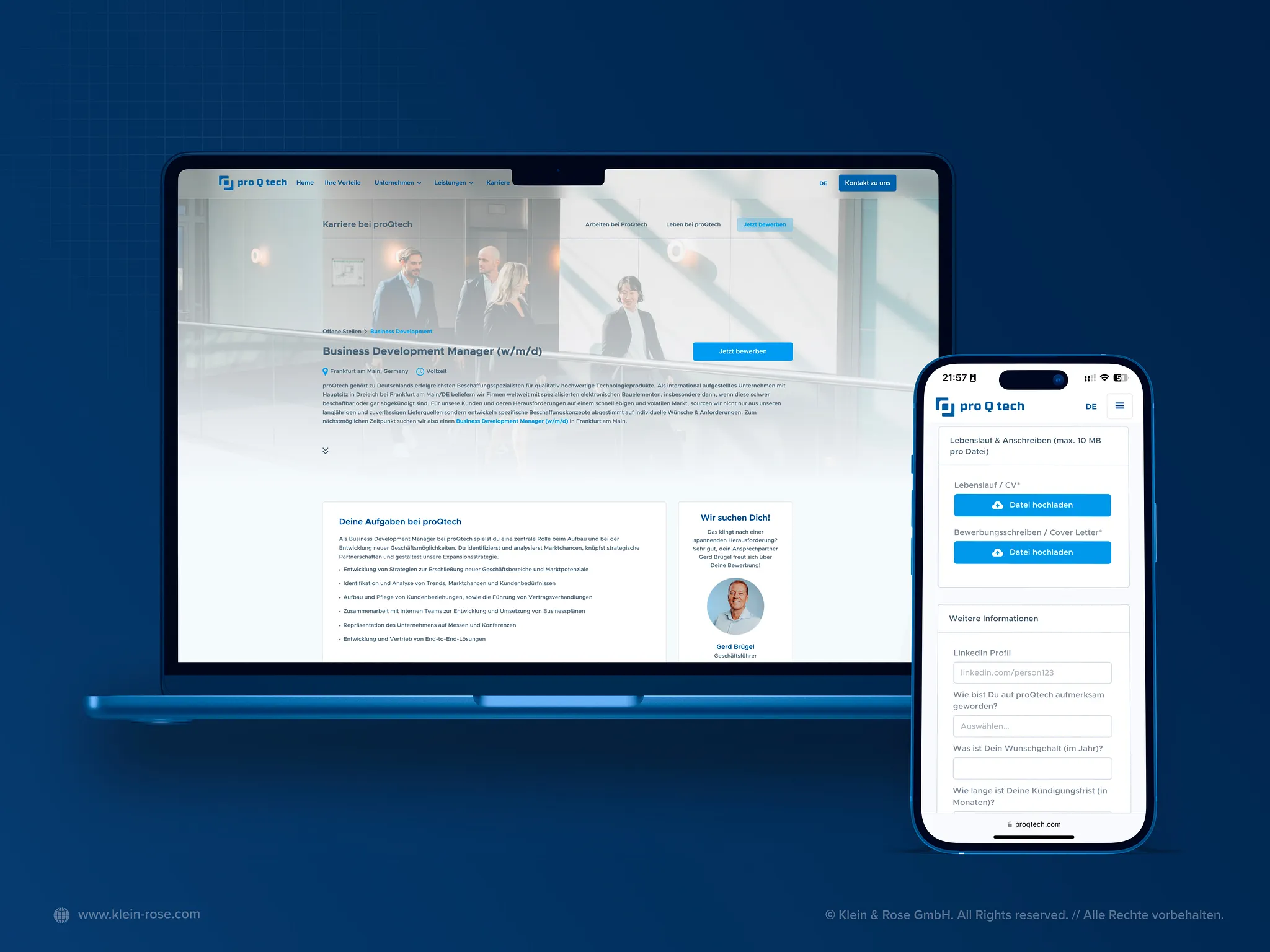
An example from our work: when we redeveloped the complete external presence of proQtech, an internationally active company in electronics distribution, one of the biggest challenges was that the company was professionally positioned at a very high level, but was barely visible in the market as an employer. The solution was a holistic approach: we treated brand identity, web design, SEO, and employer branding as one connected system, not as isolated individual measures. The result: the lead rate more than doubled, typical objections from customers and applicants disappeared, and the company was able to position itself much more strongly both in the sales market and in the labor market. One person responsible for the project put it this way: “The brand works for us 24/7.”
This example highlights a point that is often underestimated: a strong corporate brand does not only influence customers, but also potential employees. According to Glassdoor, 69 percent of job seekers would consider a job at a company with a good reputation, even if they are not actively looking for a job. So anyone who strengthens their branding overall automatically also benefits in recruiting.
In our work with companies across a wide range of industries, we see recurring patterns that slow down the success of employer branding and personnel marketing. Three of them show up especially often.
The first mistake: companies start with personnel marketing before the employer brand is in place. They invest in job ads, social media campaigns, and recruiting events without first defining which message they want to communicate. The result is measures that feel interchangeable and do not stand out from those of competitors. The strategic foundation is missing, and candidates sense that intuitively.
The second mistake: employer branding is treated as a purely HR topic. In reality, building an employer brand is a task that management, HR, marketing, and communications must carry together. If the employer brand sits only within the HR department, the resources, the budget, and the strategic connection to the corporate brand are missing. The most successful employer branding projects we have supported all had one thing in common: management was actively involved from the very beginning.
The third mistake: the internal perspective is neglected. Many companies focus on external visibility, but forget that employer branding begins with their own employees. If existing employees do not experience the employer promise, they will communicate that accordingly on review platforms and within their personal networks. An elaborate image video is of little help if the company has three stars on Kununu and former employees report a lack of appreciation.
1. To ensure that both disciplines can unfold their full effect, you should make sure of the following points:
2. Define your Employer Value Proposition before you start personnel marketing measures
3. Make sure that management, HR, and marketing work together on the employer brand
4. Derive all operational measures from the defined employer brand so that a consistent image is created
5. Check regularly whether the internal experience matches the external promise
6. Measure the success of both disciplines using different KPIs: employer image and employee satisfaction for employer branding, time to hire and cost per hire for personnel marketing
If there is one thing we have learned from supporting branding projects, it is this: the companies that are most successful in recruiting have understood that employer branding and personnel marketing are not alternatives. They are two sides of the same coin.
Employer branding provides the strategic foundation. It defines what your company stands for as an employer and creates a brand that builds trust before a candidate even sees a job ad. Personnel marketing implements that strategy operationally. It brings your message to the right target audience and guides candidates through a convincing application process.
Companies that consistently combine both experience measurable change: more qualified applications, shorter time to fill positions, lower turnover, and ultimately a stronger position in the labor market. The path there does not begin with a job ad. It begins with the question: what do we stand for as an employer? Everything else follows from that.
Would you like to find out whether your company is strategically positioned to attract the best talent? Let us identify together in a conversation where your greatest potential lies.
.webp)




.webp)


