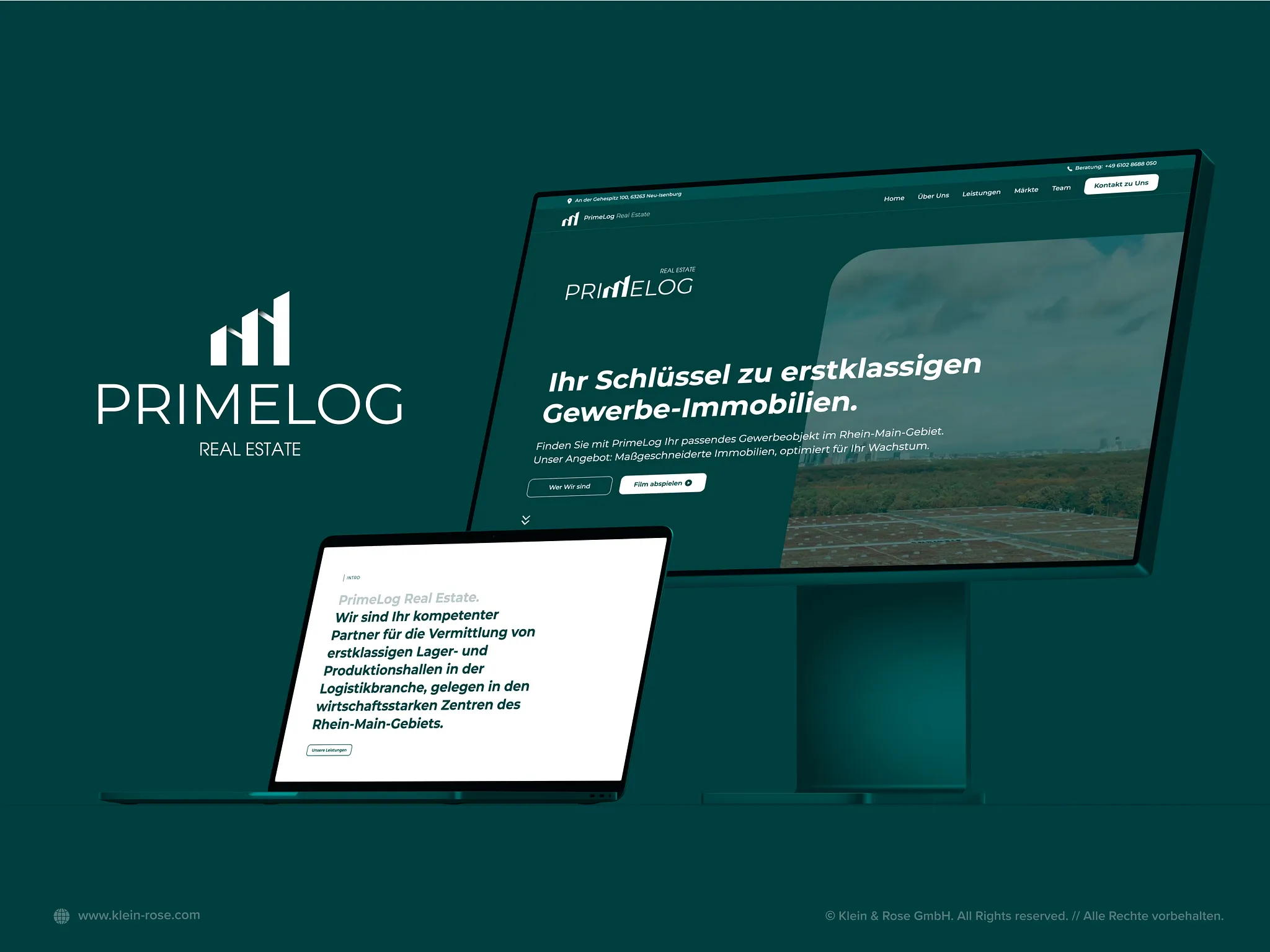
Most companies choose their web design agency based on the portfolio. Understandable: If you want to see beautiful websites, look at references. But as the sole decision criterion, this falls short. An appealing portfolio tells you whether an agency can design. It doesn't tell you if she understands your business. It doesn't tell you whether projects will be delivered on time. And it doesn't tell you whether someone will answer the phone after the launch if something doesn't work.
Choosing a web design agency is a business decision with long-term consequences. Because the agency that builds your website creates the first impression that potential customers, applicants and business partners get of your company. And that first impression isn't easy to correct.
This article gives you the criteria that really count when choosing an agency. Written from the perspective of someone who knows this industry from the inside and knows which questions are asked often and which too rarely.
This article is aimed at managing directors and marketing managers who are currently seeking offers or comparing web design agencies. You benefit in particular if you hire an external agency for the first time and are unsure how you recognize quality. Even if you've had experiences with web design agencies in the past that didn't run ideally, here are the points of reference to help you next time.
Your website isn't “just any project.” It is your company's digital handshake. For many prospects, it is the first point of contact with your brand, even before a phone call takes place or an offer is requested. What visitors see and feel on your website in the first few seconds shapes their entire perception of your company.
The wrong agency therefore not only costs you money. It costs you time because projects drag on. It costs you trust because the result is not convincing. And in the worst case, it costs you customers because your website gives the impression that your company is not taking its own public image seriously.
Nevertheless, the choice of agency is often treated as a procurement decision: get three offers, take the cheapest one, and that's it. Or: hire the agency with the most impressive portfolio without checking whether working methods and understanding go together. Both regularly lead to disappointment. The question isn't who builds the nicest websites. The question is who can build a website that works for your business.
Pay attention to how the initial conversation goes. Does the agency ask questions about your business, your target group, your goals? Or does she immediately show you design suggestions and talk about colors and layouts? An agency that starts designing before they understand your business is building a website that looks good but doesn't work. Strategy expertise is not reflected in buzzwords, but in whether someone asks the right questions before providing answers.
That doesn't mean that the agency must have worked in your exact niche. It means she has experience working with companies that have challenges similar to yours. A B2B service provider has different requirements than an online shop. A medium-sized company needs a different approach than a startup. Ask about projects with a comparable starting point and check whether the agency speaks your language or whether you feel you need to explain how your business works.
Every professional agency should be able to explain to you how a project works for them. Which phases are there? When is your input required? How are feedback and approvals handled? How long will the project realistically take? If an agency doesn't have a clear answer to these questions, it either lacks experience or internal structure. Both should make you careful. You can find out more about the ideal project process in our article on Checklist for a successful web design project.
A beautiful website is not an achievement. A website that delivers measurable results is an achievement. Ask the agency what their projects have done for customers. Have inquiries increased? Has the conversion rate improved? Was it possible to recruit new employees? When an agency only talks about design, but not about impact, the entrepreneurial eye is missing. And you need that if you want your website to be more than just a digital shop window.
A website is not a completed project. It needs maintenance, updates, occasional adjustments and development at some point. Ask what happens after the launch. Is there a maintenance contract? How quickly does the agency respond to inquiries? Will the team that built your website still be available a year from now? An agency that disappears after launch leaves you with a tool that you can't maintain alone.
References from good web design service providers are more than just a gallery of pretty screenshots. To really appreciate what an agency is doing, you need to take a closer look.
Click your way through the live projects. Not through the portfolio images on the agency website, but through the clients' actual websites. Do they charge quickly? Do they work just as well on a smartphone as on a desktop? Is navigation logical? Can you quickly find what you're looking for? Is the content up to date or does it look out of date? All of this tells you more about the quality of work than any design draft.
Also pay attention to the range of references. An agency that exclusively builds websites for an industry has deep specialization, but may have a limited perspective. An agency that works for different industries and company sizes has wider experience. Both can be right, depending on what you're looking for.
Case studies or customer testimonials that go beyond pure design are particularly informative. When a customer says “The website looks great,” that's nice. When a customer says “Since the relaunch, we have received significantly more inquiries” or “The collaboration was uncomplicated and the project was on schedule,” then the results and process quality speak for themselves. Don't be afraid to ask the agency to get in touch with a reference customer. Reputable agencies have no problem with that.
Another note about the classification: An agency with three excellent references that are exactly right for your industry or company size is more meaningful than one with fifty projects, none of which are similar to your initial situation. Quality beats quantity, even when it comes to portfolio.
.webp)
Before you compare different web design agencies, it's worth asking the basic question: Do you need an agency at all? The honest answer: not always.
If you're a sole trader or founder who needs a simple online presence, a modular system like Wix or Squarespace can be a pragmatic start. The costs are low, it's quick to set up, and that can be enough for a digital business card. The limits become apparent as soon as you need individual design, strategic structure or clean search engine optimization.
An experienced freelancer can be a good choice if your project is clearly outlined and you know what you want. Freelancers often work faster and cheaper than agencies because the overhead is lower. The downside: Most freelancers specialize in one discipline. Getting strategy, design, programming, texts and SEO from a single source is the exception for individuals. There is also no security: If your freelancer fails, your project stands still.
An agency is the right choice if you have strategic goals and want your website to be seen as a real business tool. Agencies bring a team with different competencies and can implement projects holistically. This costs more, but usually provides a result that goes beyond pure “web design.” A detailed classification of the cost differences can be found in our article How much does a professional corporate website cost?
It is crucial that you think of the choice in terms of goal, not from budget. What do you want your website to do? What are your demands in terms of quality and effect? This results in the right path.
There are signs that indicate a lack of professionalism. None of these is an exclusion criterion on its own, but when several come together, you should be careful.
You should become suspicious if an agency gives you a fixed price without having asked a single question about your project. A reputable service provider cannot calculate a realistic price without knowing your goals, scope, and requirements. Anyone who nevertheless immediately mentions a price is either working with standard solutions or deliberately calculating low in order to renegotiate later.
Please also have a look at the agency's own website. Does it appear outdated, unstructured, or technically deficient? That's when the question is why the agency is not getting a grip on its own figurehead. Of course, the old adage “the shoemaker has the worst shoes” is sometimes true. But in web design, your own website is the most important work sample.
If an agency promotes “individual design,” but all projects in the portfolio look strikingly similar, these are probably adapted templates. This is not a fraud, but it is a different service than individual design and should be priced that way.
You should also be alert if the conversation shows little interest in your company, your target group or your market. An agency that shows you design suggestions directly, without asking who you want to reach and what your website should do, will deliver a result that looks good at best but doesn't fit your business.
And finally: Pay attention to how the agency deals with maintenance and development. If the offer ends with the launch and there is no talk of ongoing support, a significant part of the overall picture is missing. A website without a maintenance concept is a risk that will be noticeable sooner or later.
.webp)
The initial consultation with a potential web design agency is your best opportunity to find out whether the collaboration can work. Use it not only to listen, but also to ask specific questions.
Ask how a typical project works at the agency. Not the glossy version, but the honest process: What phases are there? How long do they last? What is delivered in which order? The clarity and concreteness of the answer will tell you whether the agency is routine or improvising.
Ask who specifically will be working on your project. At some agencies, the managing director conducts the initial interview, and then a junior takes over. That doesn't have to be bad, but you should know it beforehand. Ask if you can get to know the people who actually design and program your website.
Ask for results from comparable projects. Not “Show me your portfolio,” but “What has your work done for the client?” The experience of MH Gewerbe-Immobilien shows what this could look like: After the new brand presence, including the website, there were more high-quality inquiries, discussions with interested parties barely revolved around fundamental trust and the company made significantly larger deals. The managing director's conclusion: “Looking back, I would rather have taken the step a year earlier.” More about the MH Gewerbe-Immobilien project.
Also ask how the agency deals with feedback and requests for changes. How many rounds of corrections are included? How is feedback collected? And what happens if you find out halfway through the project that the direction is not right?
And ask what happens after the launch. Is there a maintenance contract? How quickly does the agency respond to problems? Who is your point of contact? An agency that doesn't have a clear answer to this question isn't planning with you for the long term.
Many companies are looking for a web design agency in their region. This is understandable: personal meetings, short distances and an understanding of the local market can be real advantages. Physical proximity is particularly practical for projects that involve photography or video production.
At the same time, digitization has changed collaboration. Briefings, votes and presentations work just as well via video call as at the meeting table. Many successful web design projects are now created in collaboration across distances. It is not the location that is decisive, but the quality of communication.
If you're looking for a specialized agency that has experience with your industry or your specific requirement profile, you shouldn't artificially restrict your search to a region. The best web design agency for your business isn't necessarily the closest. She is the one who best understands your challenge and can deliver the results you need.
At the same time, if you choose between two agencies of comparable quality and one of them is based in your region, proximity can be decisive. Personal appointments create trust and make collaboration more human. Especially when it comes to the first joint project, this should not be underestimated.
Looking for the right web design agency is not a search for the best portfolio or the cheapest offer. It is the search for a partner who understands what you want your website to do for your company and who has the expertise to do just that.
At a time when almost every company has a website, the difference is not made by the presence of a website, but by its quality. The agency you choose today will influence how your company is perceived over the next few years. From customers, from applicants, from business partners.
Take the time to make a careful selection. Ask the right questions Don't just check references superficially. And choose an agency that gives you the feeling that your project is not just one of many, but one that is implemented with entrepreneurial understanding and genuine commitment.
In the end, the best web design agency for your company is the one whose initial consultation makes you think: They have understood what we are about. When that feeling is there, the rest is usually right too.
Are you looking for an agency that not only designs, but also thinks along with you? Let us find out in a non-binding conversation whether we are a good fit for each other.
.webp)


.webp)

.webp)