Most companies have a website. But very few have a website that works.
You may be familiar with this: You invested in a website a few years ago, the design still looks decent, the content is basically right. Nevertheless, there are hardly any inquiries via the website. Potential customers call and ask questions that should actually be answered on the website. Or even worse: They don't even call because the first impression wasn't convincing.
This is exactly where the difference between a website that exists and a website that sells lies. Professional web design for companies is much more than an appealing layout. It is the interface between your brand, your services and the people you want to reach. In this article, we'll show you what really matters, which mistakes you should avoid and how a corporate website can become a real business driver.
This article is aimed at managing directors, owners and marketing managers who are planning a new company website or would like to fundamentally question their existing one. You particularly benefit when you feel that your website isn't doing what your business deserves. Whether you're just requesting a quote for a new corporate website, looking for a web design agency for your company, or simply want to understand what makes a professional corporate website today, you'll find the answers here.
Professional web design for companies means the strategic conception, design and technical implementation of a website that is specifically geared to the company's business goals. It combines visual design with user guidance, technical performance and a search engine-friendly structure to convert visitors into customers.
This definition sounds abstract at first. Let's take a look at what that means in practice.
A professional corporate website is not a digital flyer. It is not an end in itself and not just a figurehead. It is a tool that works around the clock for your company. This means that each page has a clear purpose. Each text is tailored to the questions and needs of your target group. Each design element supports user guidance and trust in your brand.
At this point, the question often comes up: What is the difference between a homepage and a website? The homepage is the start page of your website, i.e. the page that visitors see first when they visit your domain. The website, on the other hand, is the entire website with all sub-pages, from the service overview to the team to the blog. So when we talk about web design for companies, we mean the design of the entire website.
The key point that many underestimate: People buy with their eyes. The first visual impression determines in fractions of a second whether a visitor stays or leaves. Professional web design makes targeted use of this principle. It provides immediate orientation, imparts competence and builds trust even before a single text is read.
By the way: If you already have a website and would like to fundamentally renew it, we are talking about a Website relaunch. The difference to a web design project lies in the starting point. A relaunch builds on an existing structure and takes existing rankings, content and legacy technical issues into account. A new web design project often starts on white paper.
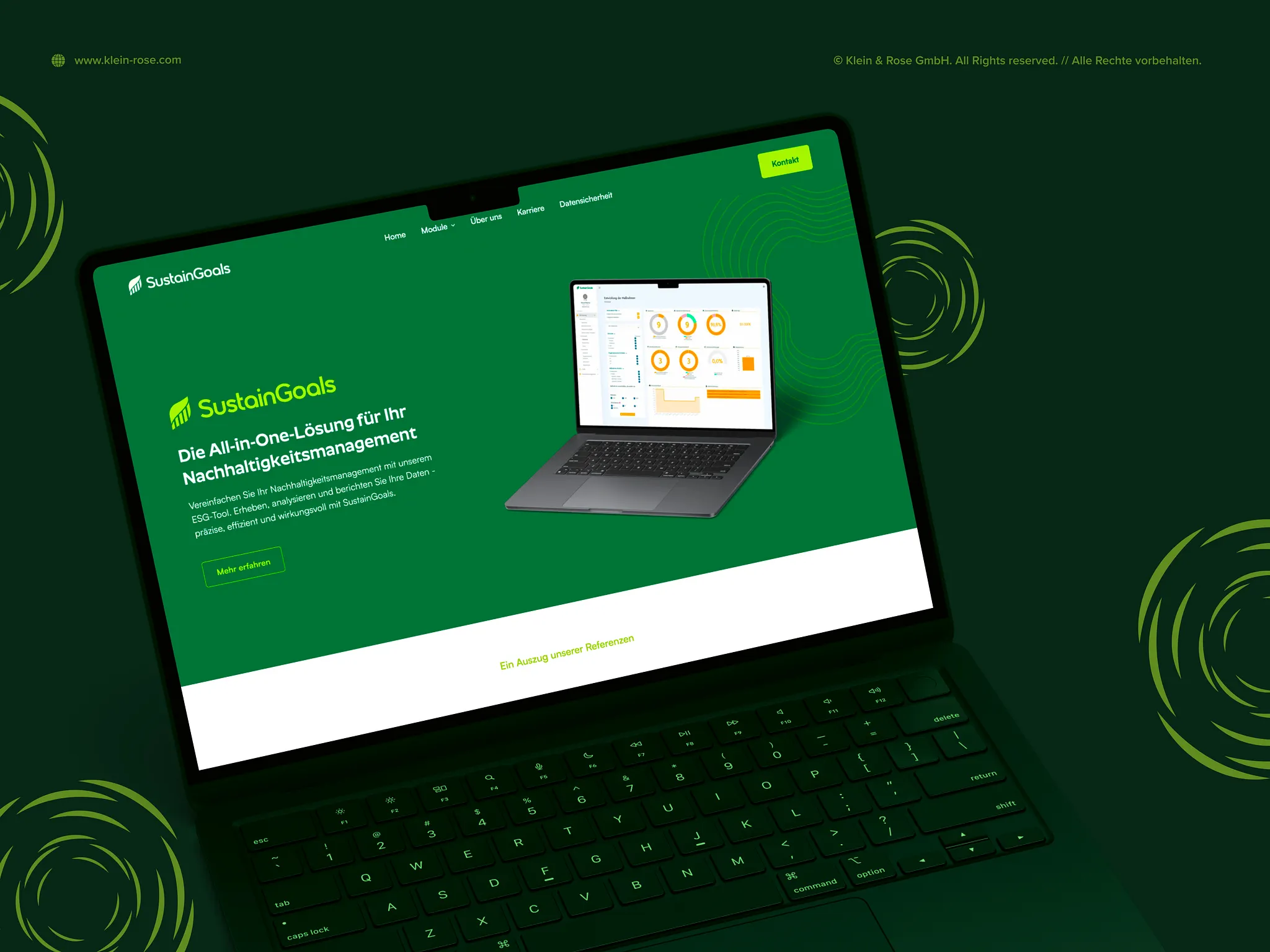
In over 25 website projects for companies in industries such as real estate, consulting, SaaS and hospitality, we have seen one thing over and over again: The websites that deliver measurable results share certain basic characteristics. And these have less to do with aesthetics than many think.
Clear positioning and target group approach. A website that wants to appeal to everyone will not reach anyone in the end. Professional web design therefore does not start on the screen, but with the question: Who do we want to reach and what should this person do? This is the basis for tonality, visual language, page structure and the entire user interface. If a visitor recognizes within the first few seconds whether they are in the right place, half the job is done. This is particularly true in the B2B sector, where decision makers often compare several providers at the same time and have little time. Your website must deliver the right answer right now.
Sales psychological structure. A professional corporate website doesn't just look good. It systematically guides the visitor from initial interest to action. It starts with a strong headline that addresses the core problem of the target group. It continues with signs of trust such as references, customer testimonials and seals of approval. And it ends with a clear call to action that makes it easy for the visitor to take the next step. Sales psychological web design does not mean selling aggressively. It means breaking down barriers and building trust.
Technical performance. Charging time is not a nice-to-have. It is a ranking factor and a conversion killer at the same time. If your website loads longer than three seconds, you'll lose a significant portion of your visitors before they've even seen anything. Professional web design takes Core Web Vitals, mobile optimization, and clean code into account right from the start. Because a nice website that loads slowly isn't a good website.
SEO foundation right from the start. Setting up search engine optimization retrospectively on a website is like wanting to have a basement of a house retrospectively. It works, but it's more expensive and complex than necessary. Professional web design includes SEO from the very beginning: page structure, URL logic, heading hierarchy, loading speed, meta data. All of this belongs in the design phase, not in rework. Anyone looking for web design services with integrated SEO for companies should make sure that both come from a single source.
scalability and maintainability. Your website is about to change. New services are added, team members change, content needs to be updated. Professional web design takes this into account right from the start. That means: a content management system that your team can use. A modular page structure that can be extended. And a technical basis that will still be up to date in three years.
When we talk about web design for companies, the question quickly comes up: Do the same rules apply to a sole trader as to a company with 200 employees? The basic principles, yes. Implementation, no.
Web design for small businesses doesn't automatically mean “kit and done.” A craft business, law firm or local service provider also needs a website that creates trust and generates inquiries. The difference is more in the scope: Where a small company makes do with five to ten well-thought-out pages, a medium-sized company often needs a more complex structure. Multilingualism, career portals, connection to CRM systems or product databases are typical requirements that grow with the size of the company.
Internal processes also differ. In small companies, the owner often makes the decision alone. In medium-sized companies, management, marketing, sales and sometimes IT are involved. This has an impact on the project flow, the coordination processes and thus also on the costs and duration of a web design project.
What is no different: The demand for quality. A poorly made website hurts a small business just as much as it does a medium-sized one. Perhaps even more, because there are fewer points of contact with the brand and the website must therefore weigh all the more heavily.
In principle, whether five pages or fifty, the strategic claim remains the same. Each page must serve a purpose, every text must be tailored to a target group, every design element must support user guidance. The difference lies in the scope and complexity of the implementation, not in the quality of the thinking behind it.
The honest answer to the question “How much does a professional corporate website cost?” It means: It depends. And anyone who gives you a flat rate without knowing your project is doing something wrong.
What we can tell you: Professional web design for a company is an investment that translates into customer acquisition, trust building, and revenue growth when done right. What we at Girasole Restaurant confirmed this: Following the development of a new brand presence including a website, the restaurant recorded a sustained increase in sales, both digitally and locally. Investing in professional web design has not proven to be a cost factor here, but as a growth lever.
The costs depend on various factors: page size, functionality, whether an existing branding is used or a new one is being developed, whether texts and photos already exist, and how individual the technical implementation should be. A website with ten pages can cost between a few thousand and tens of thousands of euros, depending on the requirements and the agency. Monthly operating costs for hosting, maintenance and minor adjustments are typically in the low three-digit range.
If you want to understand the topic of costs in detail, you can find a detailed breakdown in our separate article: How much does a professional corporate website cost?
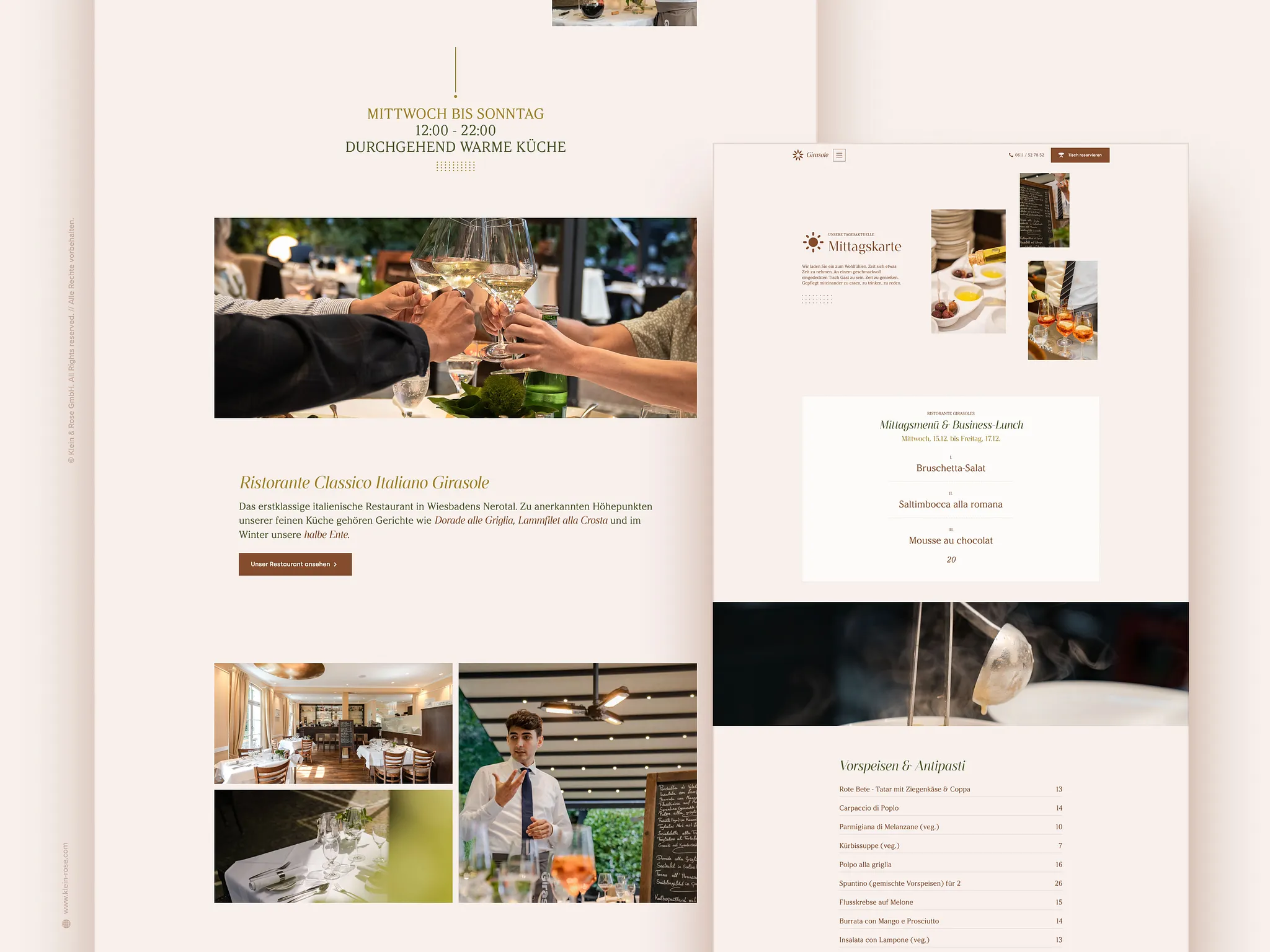
Finding a web design agency for your company is not a purely professional decision. It is an entrepreneurial one. Because the agency that builds your website ultimately creates the first impression that potential customers get of your company.
What should you pay attention to? First, on the portfolio. Don't just look at the screenshots, click through the live projects. Do the sites also work on mobile devices? Do they charge quickly? Are they structured and understandable? The references of good web design service providers not only show whether an agency can design “beautifully”, but whether it builds websites that deliver business results.
Then: industry experience. An agency that has experience with companies of your size and industry understands your challenges faster. She asks the right questions in the briefing and provides solutions that suit your market. This saves time, money and nerves.
In addition, pay attention to the process. Reputable web design agencies don't start with the design, but with the strategy. If you don't know your target group, you can't build a website that appeals to them. Ask what the project process looks like, what milestones are there and how feedback is incorporated. Good agencies work transparently and involve you in key decisions without overwhelming you with technical details.
Another point that is often overlooked: Ask about maintenance and development. A website is not a completed project. It needs regular maintenance, updates and occasional content adjustments. The best web design agency is of little use to you if they are no longer available after launch.
Briefly explained: How do I hire a web design agency for my company? The process usually begins with a non-binding initial consultation, in which goals, scope and budget are discussed. This is followed by an offer. After assignment, the strategy phase starts, followed by conception, design and implementation. For professional agencies, the entire process typically takes two to three months.
A complete decision guide with all selection criteria can be found here: Find and hire a web design agency
Many companies invest five-digit amounts in professional web design and then wonder why the website is not found on Google. The reason is almost always the same: SEO was seen as a separate project that should come at some point “after launch.”
It's a costly mistake. Because a website without an SEO foundation is like a retail store on a side street without signs. It may look great on the inside but no one can find the way in.
What does “web design services with integrated SEO” actually mean? It means that it is already determined in the design phase which pages are optimized for which search terms. That the URL structure is logical and search engine friendly. That headlines, meta titles and descriptions are formulated strategically. That the loading time is optimized right from the start and that the site works perfectly on all devices.
This also includes the question of what content is actually needed on the website. A professional corporate website without a blog or advice area wastes enormous potential. Because it is precisely this content that ensures that your website appears in relevant search queries, even those that you may not have even thought of yet. If you're looking for “web design for small businesses” today, you might end up on your services page tomorrow.
Briefly explained: Search engine optimization (SEO) comprises all measures that help make a website easier to find in the organic search results of Google and other search engines. This includes technical optimizations, content measures and the creation of links.
When web design and SEO come from a single source, it not only saves time and coordination effort. It also ensures that no technical design decisions are made that jeopardize the SEO foundation. If you want to dive deeper into the topic of search engine optimization, check out our article on SEO for SMEs detailed instructions.
If you've read this far, one thing is clear: web design for companies is more than just a pretty layout. It is the combination of strategy, design, technology, and content that determines whether your website gains customers or loses visitors.
The most important points summarized: A professional corporate website needs a clear positioning, a sales psychology structure, technical excellence, an SEO foundation and the ability to grow with your company. The right web design agency and the right technology are just as crucial as the content itself.
The most common mistake we hear in initial meetings: “Our website still looks good.” But looking good and working well are two different things. A website that doesn't generate queries, that doesn't build trust, and that isn't found on Google isn't a good website. No matter how modern it looks.
Better branding = less objections = more trust = more revenue. This formula applies to any corporate website, regardless of industry or size. Anyone who invests in professional web design invests in the most important sales channel, which works around the clock for their company.
At Klein & Rose, we have been developing individual websites for companies in a wide range of industries for over five years. As winners of the German Web Award, we know what a website must do so that it not only looks good but also delivers results.
Do you feel that your current website doesn't reflect your company's potential? Let's see together where the biggest levers lie. We're looking forward to getting to know you.
.webp)



.webp)
.webp)


