A typical scenario that we regularly experience: A company opts for a new website. The service provider is selected, the contract is signed, everyone is motivated. Then nothing happens for three weeks. Not because the agency doesn't deliver. But because it is unclear internally who is giving feedback. Because the lyrics aren't ready yet. Because no one knows where the login details for domain and hosting are. Because the managing director actually has a different idea than the marketing manager.
The result: The project takes twice as long as planned, the budget is strained and motivation on both sides decreases. Yet all of this would have been avoidable.
In this article, we'll show you what you can do as a company before and while your web design project is running to make it run smoothly. Not just a theory, but a practical checklist based on the experience of numerous website projects that we have implemented together with our customers.
This article is aimed at managing directors and marketing managers who are planning a specific web design project or have already selected an agency. You particularly benefit if you hire a web design agency for the first time and want to know how the process works and what is expected of you. Even if you have had bad experiences with web projects in the past and want to do it the right way this time, you can find the guidelines here.
The most important preparation is not done at the computer, but during a conversation. Before you request a quote for a new company website or contact an agency, you should have clarified three questions internally.
First: What should the website do? That sounds obvious, but it's surprisingly often skipped over. “A new website” is not a goal. “We want to generate ten qualified inquiries a month via the website” is one goal. “We need a career portal that appeals to specialists” is one goal. “Our competition has a better website” is a motivator, but not a goal. The more clearly you can state what the website should do for your company, the better each service provider can work for you.
Second: Who do you want to reach? Your website isn't talking to you. She talks to your customers, applicants, partners. Consider who your key audiences are and what they expect when they land on your website. A medium-sized buyer has different questions than an applicant. A managing director who is looking for a service provider has different expectations than someone who just wants information. This clarity helps the agency enormously with the design.
Thirdly: Who decides? This point is most often underestimated. When three people give feedback but no one has the final approval, endless loops occur. Before the project starts, determine who is the central point of contact for the agency, who provides content feedback and who will give approval at the end. Ideally, that is one person. In larger companies, there are a maximum of two to three people with clearly distributed roles.
You should also clarify your time availability. A web design project needs your attention. Not daily, but intensive in certain phases. If you know that the trade fair is coming up in October and no one has time before that, then September is not a good month for the feedback phase. Communicate such framework conditions early on so that the schedule can be realistically planned.
.webp)
If we had to distill a single tip from all our previous projects, it would be this: Take care of the content early on. Texts, images, and videos are the most common reason for project delays. Not because they aren't important, but because they're underestimated.
Start by taking stock. Which texts already exist? Are they still up to date? Which can be revised, which must be completely rewritten? The same goes for images: Do you have professional photos of your team, your premises, your products? Or have you worked with stock photos so far? Authentic photography makes a significant difference to the credibility of a corporate website. Stock images recognize visitors immediately, and do not create trust.
When it comes to texts, you have three options: write it yourself, hire an external copywriter or solve the text creation via a web design agency. All three paths are justified. If you write yourself, you save budget, but need significantly more time and should ensure that the texts are formulated in a search engine optimized manner. An external copywriter has a routine, but must be well briefed. Many agencies offer web design services with integrated SEO and copywriting as a complete package, which has the advantage that concept, design and content come from a single source.
A tip that improves collaboration with any agency: Collect three to five websites that you like. Not necessarily from your industry. For each website, write down exactly what you like about it. Is it the figurative language? The structure? The tonality of the lyrics? The colors? These references give the agency a feel for your aesthetic ideas and save lengthy coordination loops during the design phase.
Technical preparations are less complex than the content, but they are just as important. Nothing slows down a project as reliably as a lack of access data.
Clarify who manages your domain and where it is registered. Make sure that you have access to the domain provider or that the person in the company who has this access is involved in the project team. The same goes for hosting: Where is your current website located? Who has the login details? Should hosting be retained or changed?
If you use Google Analytics, Google Search Console, or other tracking tools, have these accesses ready as well. The data from these tools is valuable to the agency because they show which pages of your current website are being visited, which search terms visitors come from and where the biggest jumping points are. This information flows directly into the design of the new website.
Also list all external tools and systems that are or should be connected to the website: CRM system, newsletter tool, booking software, online appointment scheduling, social media channels. The earlier the agency knows which interfaces are needed, the more realistically it can estimate the effort and budget.
A good briefing is not a 30-page document. It is a clear, honest summary of what you imagine and what you expect. And it contains information that most companies keep to themselves: the budget framework.
Why is that important? Because an agency without budget orientation plans in fog. She doesn't know whether you're imagining a solution in the mid-four-digit range or in the five-digit range. The result: Either the offer becomes too high and you wave away, or it is calculated too low and the quality suffers. If you openly say “Our framework is X to Y,” the agency can honestly answer what is realistic within that framework and what is not. You can find out more about budget and cost planning in our article How much does a professional corporate website cost?
What else should a briefing include: Your goals (see above), your target group, the desired scope (number of pages, desired features), a realistic schedule, existing materials (branding, texts, photos) and, if available, your website references. If you already have a corporate design, send the files along with it. If not, this is important information for the agency because it significantly changes the scope of the project.
A common misconception: “Just do it, you're the experts.” That sounds like trust, but it's problematic in practice. Because good web design is always created in dialogue. The agency brings expertise in design, technology and strategy. But you bring the knowledge about your company, your customers, and your market. Both together produce the best result.
.webp)
A professional web design project follows a structured process. If you understand the individual phases, you also know when your cooperation is required and when you can lean back.
At the beginning, there is the strategy and conception phase. Here, the findings from the briefing and initial discussion are translated into a specific page structure. Which pages does the website need? In which order is information presented? Which actions should the visitor perform on which page? In this phase, a wireframe is often created, i.e. a schematic representation of the page structure without a design. This is your most important moment for feedback, because making changes to the structure is now easy. They get expensive later on.
This is followed by the design phase. Based on the approved structure, the visual concept is developed: colors, typography, visual language, layout. Many agencies start with two to three pages as a design draft before designing the entire website. Give honest feedback here. “I don't like it” doesn't help anyone. “The imagery seems too cool, we want to come across as more approachable,” gives the agency a clear direction.
After design approval, it's time to implement: programming, content integration, technical optimization. In this phase, your website is built. As the client, you now provide the final texts and images, if this is not done by the agency. The more punctual and complete your deliveries are, the smoother this phase runs.
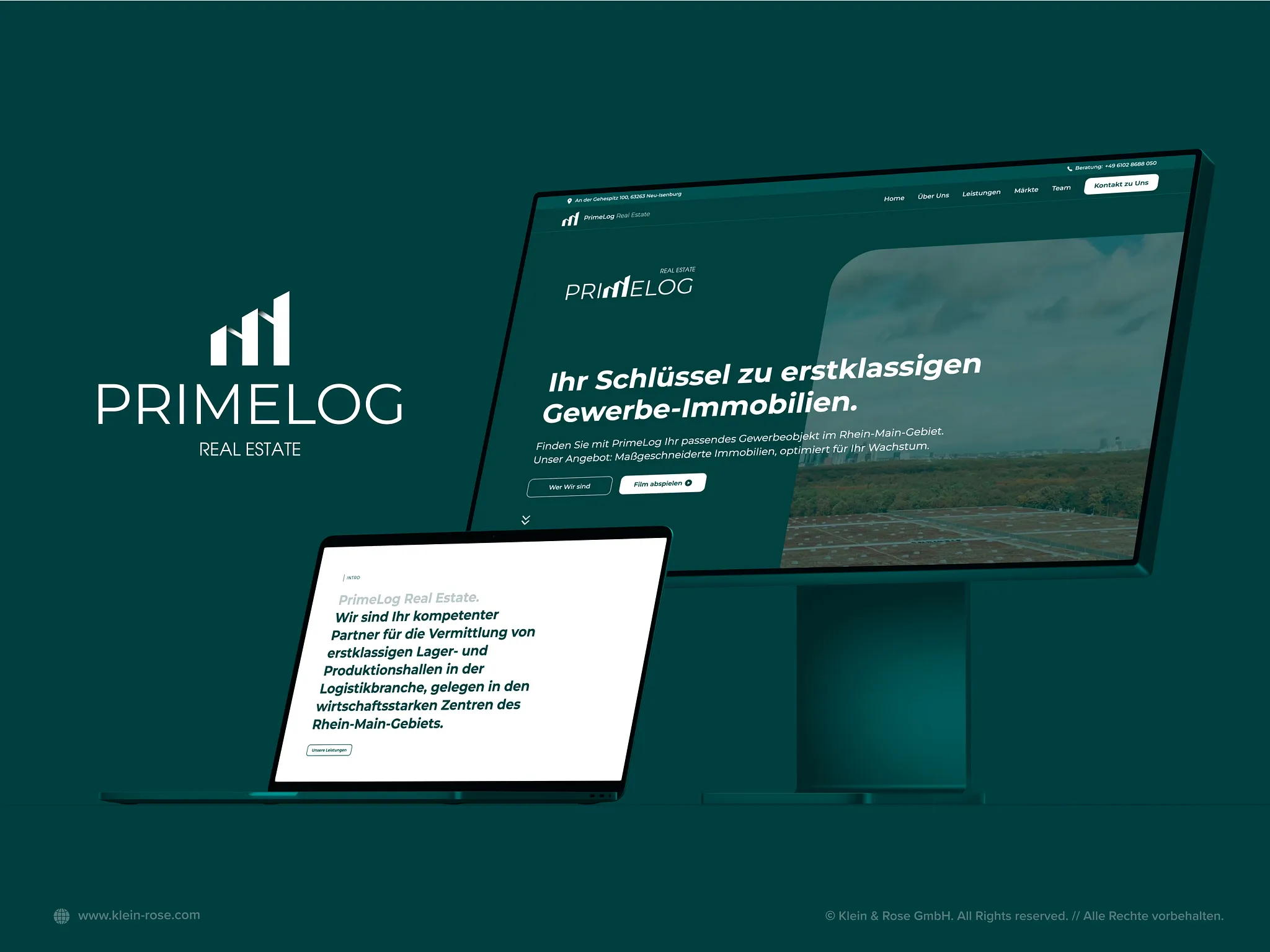
Our project with PrimeLog Real Estate shows what this can look like in practice: From the initial briefing to the finished website including branding, web design, SEO and image film, the project was structured and efficient through close cooperation. The result: increasing customer inquiries shortly after launch. More about the PrimeLog Real Estate project.
The test phase follows before the launch. The website is checked on various devices and browsers, all forms are tested, all links are checked. Also plan a round of corrections internally, ideally with the people who will work with the website later on. Small things such as a wrong contact person on the contact page or an outdated photo are often only now noticed.
The launch itself is then a clearly defined step: DNS conversion, set up redirects (if an existing website is replaced), activate tracking, final check. A good launch is not an adventure, but a planned process.
In every web design project, there are points where it can hook. The good news is that most of them are predictable and preventable.
The most common pitfall is a lack of clarity of decision. When three opinions are equally juxtaposed in the feedback round and no one decides, the project goes round and round. This costs time, money and nerves on both sides. The solution is simple: Clarify who has the last word before the project starts. And stick to it.
The second most common stumbling block: Content is delivered too late. The agency is waiting for texts, the texts are waiting for internal approvals, the internal approvals are waiting for the managing director, who is currently traveling. If you know that copywriting takes longer internally, actively schedule this or outsource the task. An empty website structure without content cannot be assessed sensibly and leads to delays in all subsequent phases.
And finally: SEO is only considered after launch. This is a mistake that is costly later on. Page structure, URL logic, load time and meta data must be incorporated into the design from the start. Why this is so important is explained in our main article on Web design for companies described in detail.
The launch is a milestone, but not an end point. Your website needs ongoing attention to make it work over the long term.
In the first four to eight weeks after launch, you should watch performance. How are visitor numbers developing? Are inquiries made via the contact forms? Are there any technical problems that were not identified during the test run? Set up Google Search Console, if you haven't already, and see what search terms your pages are showing up for. This gives you early signs of whether the SEO basics are taking effect.
In addition, every website needs regular maintenance. CMS updates, plugin updates, security patches, and backups are mandatory. Clarify with your agency whether a maintenance contract makes sense and what it covers. A detailed classification of running costs can be found in our article How much does a professional corporate website cost?
Also plan the development of content. A website that no longer changes after launch loses relevance. New services, current projects, blog posts, team changes: All of this should be displayed on the website as soon as possible. Clarify internally who is responsible for care and how often updates are carried out. And feel free to think of phase two: Which features were not yet in the budget at launch, but could be retrofitted in six months?
The best web design projects we've experienced had one thing in common: The company was well prepared. Not perfect, not planned down to the last detail. But prepared enough to ask the right questions, make clear decisions and deliver the necessary supplies on time.
Your web design project won't fail due to technology. It won't fail because of the design. If it fails, it's due to unclear goals, lack of content, or too many decision makers without structure. And that is exactly what you have in your hands.
Use this checklist as a guide for your next corporate website. Not every point has to be perfect before the first agency meeting. But the more you clarify in advance, the better the result will be. And the more fun the process is.
Are you planning a web design project and want to make sure that it runs correctly right from the start? We'd love to talk to you about the next steps. Non-binding and on equal footing.
.webp)



.webp)
.webp)